00 Overview
Class 7 — lecture of 27 September 2026, eight scanned pages (main copy) plus a condensed 3-page alternate notebook copy — opens the Chemical kinetics unit with the three classical pictures of why reactions go at the rate they do. The page sequence is continuous: collision theory → the steric factor → the Lindemann unimolecular scheme → pressure effect → transition-state theory (Eyring) → significance of the Eyring equation → comparison with Arrhenius → comparison with collision theory → advantages of the T.S. theory.
Collision theory (Sections 1–2) — reaction begins with molecular collision; only activated collisions count; the steric factor patches the gap between calculation and experiment. Lindemann (1922) (Sections 3–5) — a time lag between activation and decomposition lets unimolecular reactions be first order; the steady-state rate law changes order with pressure. Transition-state theory (Sections 6–11) — reactants form an activated complex in equilibrium; Eyring's four-step derivation lands at ; and the comparisons show where the Arrhenius and the steric really come from.
This lecture carried zero numericals — a pure theory class. Every result is a derivation, so the revision strategy is the chain in Section 14, not a problem set.
- Sections 1–2 build collision theory: the Boltzmann factor , effective collisions, and the steric correction .
- Sections 3–5 the Lindemann scheme: the N2O5 example, the three-step mechanism with its K/k notation, the steady-state rate law, and the 1st↔2nd order pressure limits.
- Sections 6–8 transition-state theory: the activated complex, Eyring's equation in four steps (i–iv), and why ΔG* alone decides the rate.
- Sections 9–11 the two comparisons — what and mean in thermodynamic language — and the advantages of T.S. theory.
- Sections 12–16 equation sheet, symbol table, rapid revision, editor's notes, raw scans.
01 The collision theory
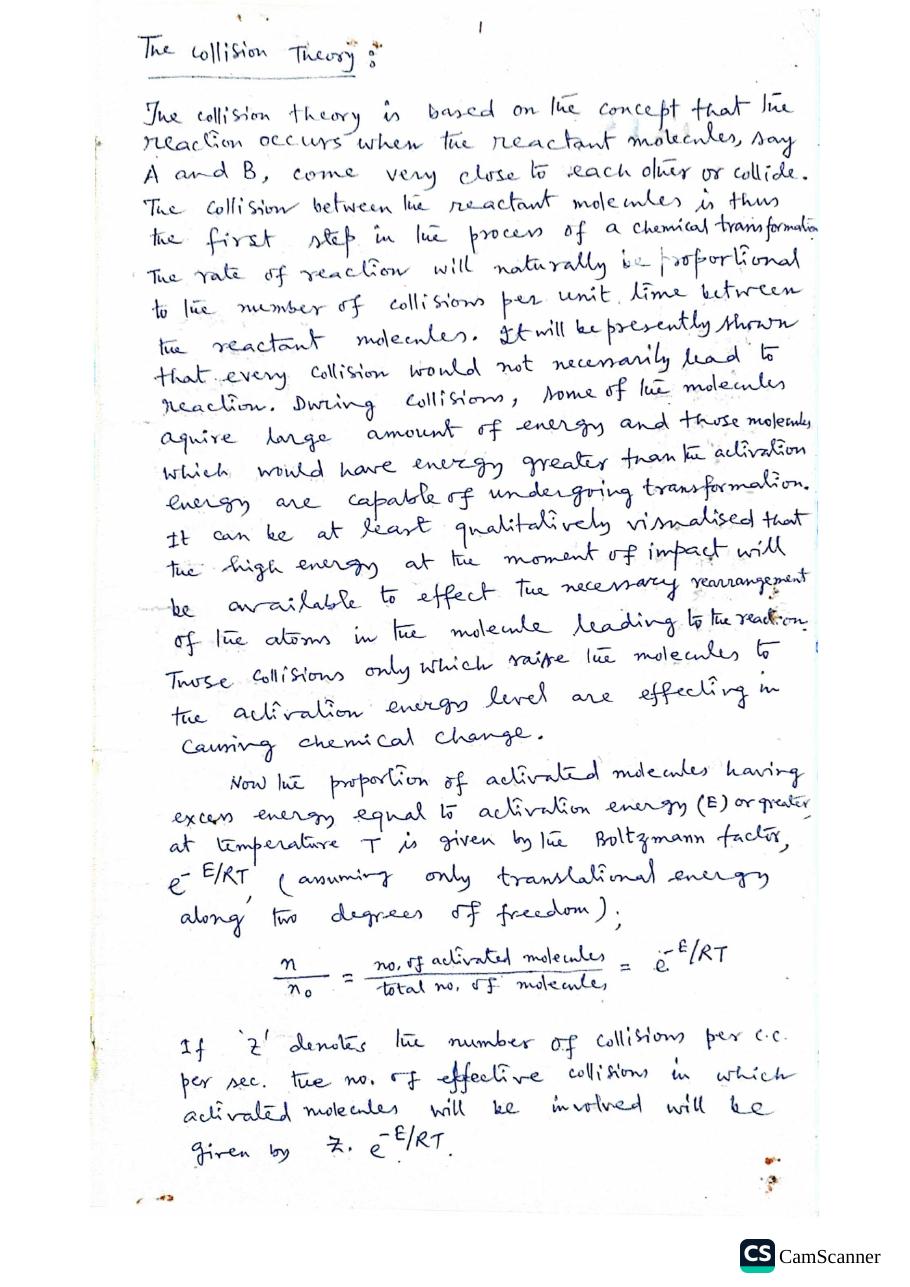
The collision theory is based on the concept that the reaction occurs when the reactant molecules, say and , come very close to each other or collide. The collision between the reactant molecules is thus the first step in the process of a chemical transformation.
The rate of reaction will naturally be proportional to the number of collisions per unit time between the reactant molecules. It will be presently shown that every collision would not necessarily lead to reaction. During collisions, some of the molecules acquire large amount of energy and those molecules which would have energy greater than the activation energy are capable of undergoing transformation. It can be at least qualitatively visualised that the high energy at the moment of impact will be available to effect the necessary rearrangement of the atoms in the molecule leading to the reaction. Those collisions only which raise the molecules to the activation energy level are effecting in causing chemical change.
Now the proportion of activated molecules having excess energy equal to activation energy or greater at temperature is given by the Boltzmann factor (assuming only translational energy along two degrees of freedom):
If denotes the number of collisions per c.c. per sec., the no. of effective collisions in which activated molecules will be involved will be given by .
Hence, the rate of transformation per c.c. per unit time, is
02 Effective collisions & the steric factor P
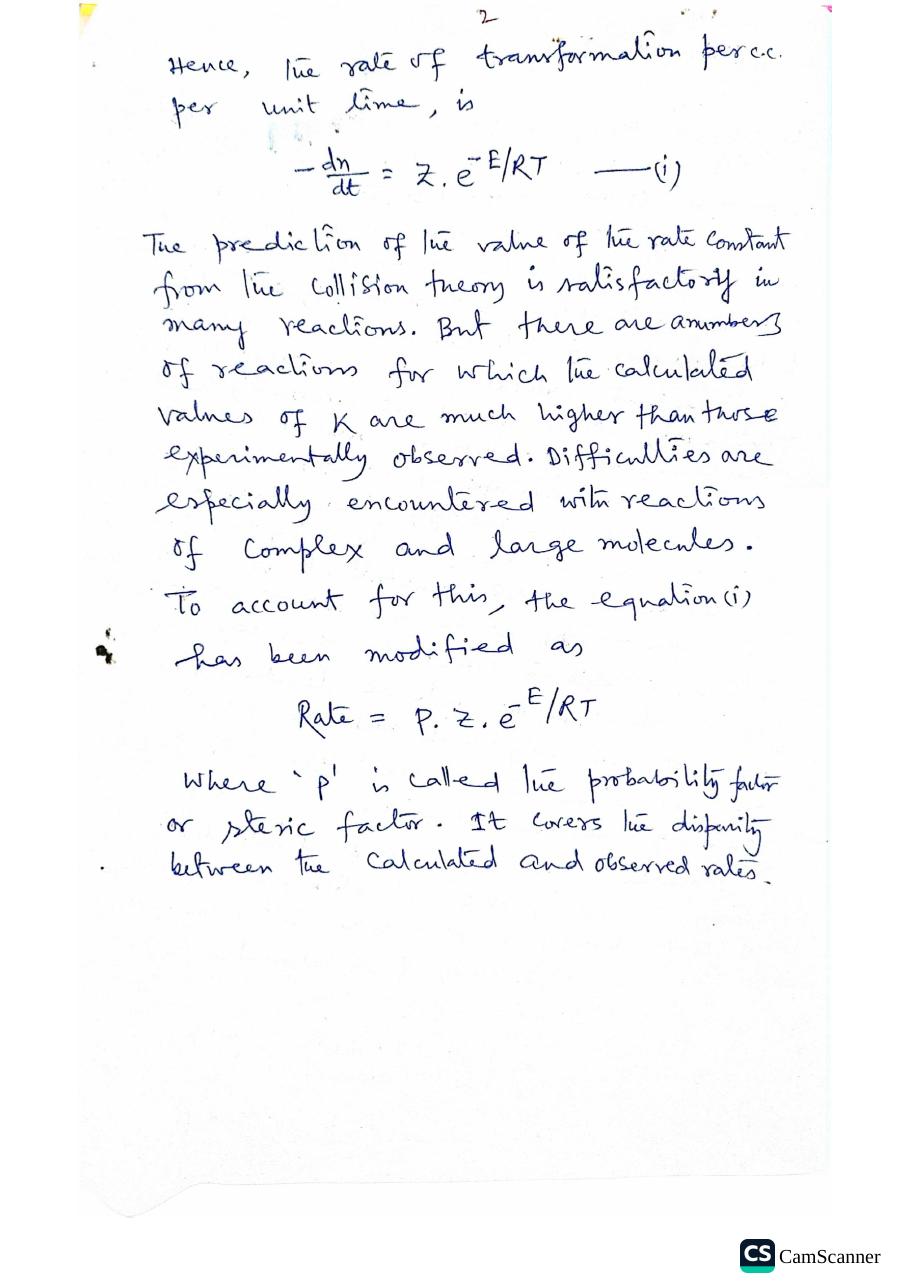
The prediction of the value of the rate constant from the collision theory is satisfactory in many reactions. But there are a number of reactions for which the calculated values of are much higher than those experimentally observed. Difficulties are especially encountered with reactions of complex and large molecules. To account for this, the equation (i) has been modified as
where is called the probability factor or steric factor. It covers the disparity between the calculated and observed rates.
is, for now, a fudge factor: it absorbs every reason a collision with enough energy still fails — wrong orientation, wrong geometry of attack, complex molecular shape. Section 10 will show where it really comes from (the entropy of activation).
03 Unimolecular reactions: the Lindemann scheme
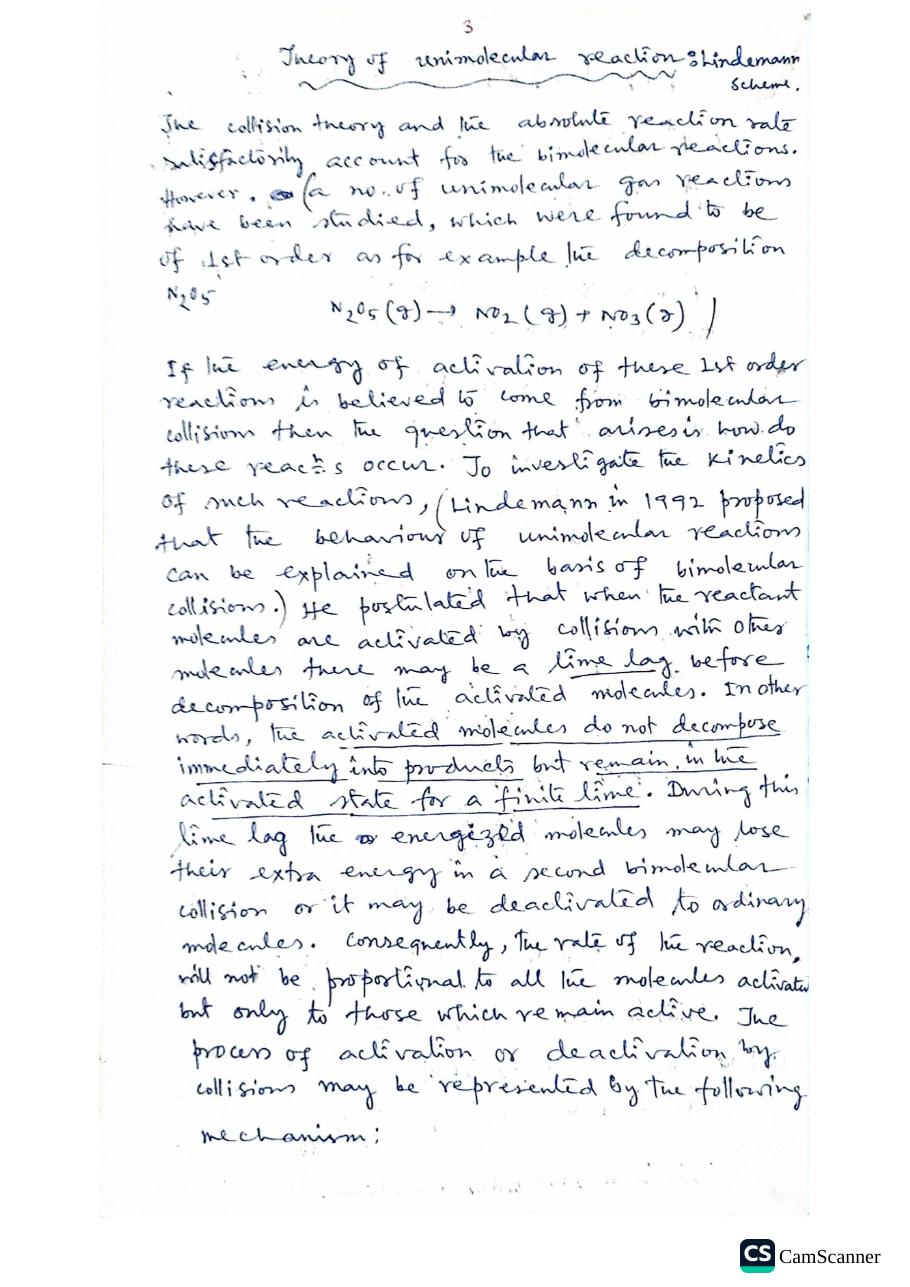
The collision theory and the absolute reaction rate satisfactorily account for the bimolecular reactions. However, a no. of unimolecular gas reactions have been studied, which were found to be of 1st order — as for example the decomposition of :
If the energy of activation of these 1st order reactions is believed to come from bimolecular collisions then the question that arises is how do these reactions occur. To investigate the kinetics of such reactions, Lindemann in 1922 proposed that the behaviour of unimolecular reactions can be explained on the basis of bimolecular collisions.
He postulated that when the reactant molecules are activated by collisions with other molecules there may be a time lag before decomposition of the activated molecules. In other words, the activated molecules do not decompose immediately into products but remain in the activated state for a finite time. During this time lag the energized molecules may lose their extra energy in a second bimolecular collision or it may be deactivated to ordinary molecules. Consequently, the rate of the reaction will not be proportional to all the molecules activated but only to those which remain active.
04 The mechanism & steady-state derivation
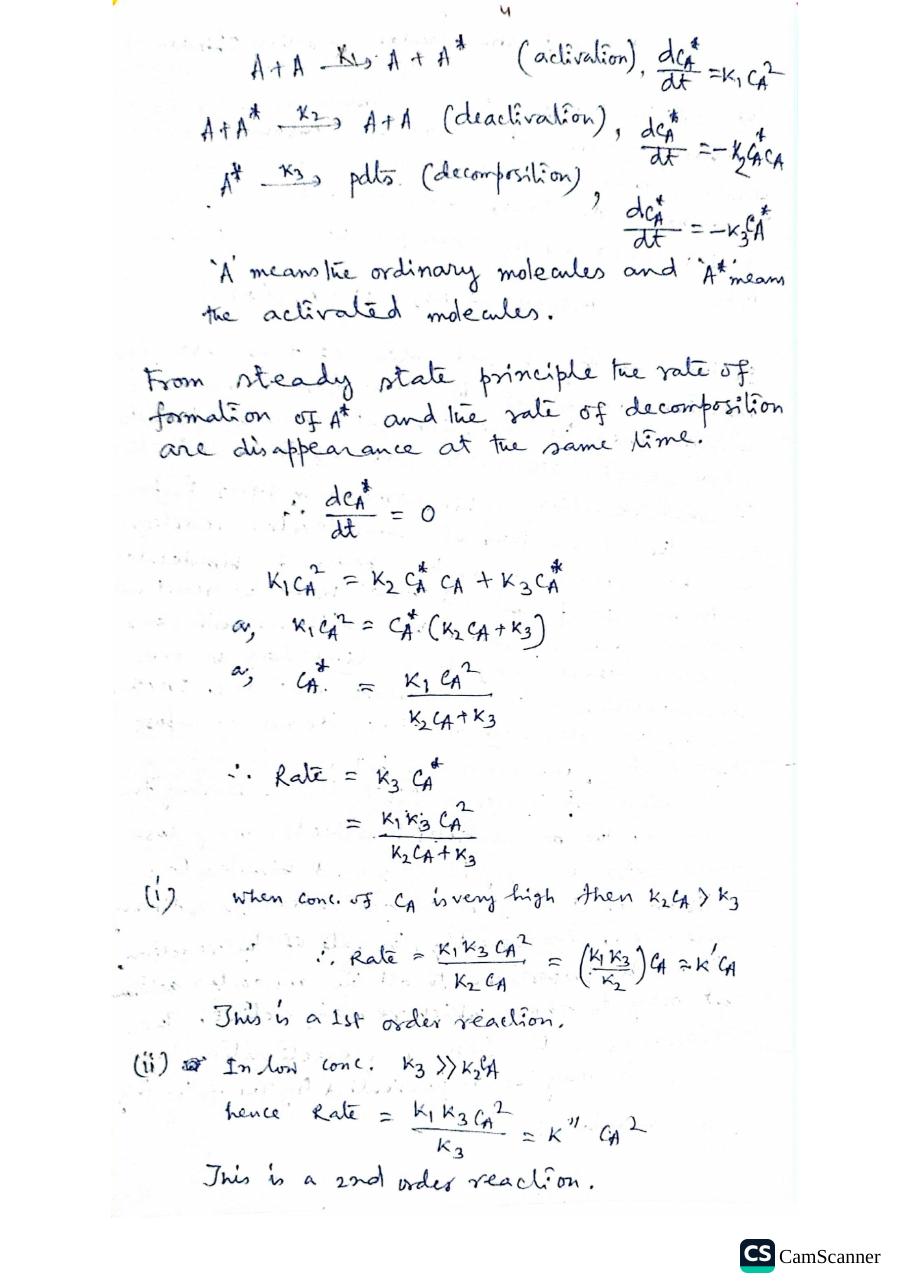
The process of activation or deactivation by collisions may be represented by the following mechanism:
means the ordinary molecules and means the activated molecules. Note the notebook's own quirk, preserved throughout: the mechanism arrows carry capital while the rate equations use lowercase .
From the steady state principle, the rate of formation of and the rate of decomposition and disappearance at the same time:
or,
or,
05 High-pressure and low-pressure limits
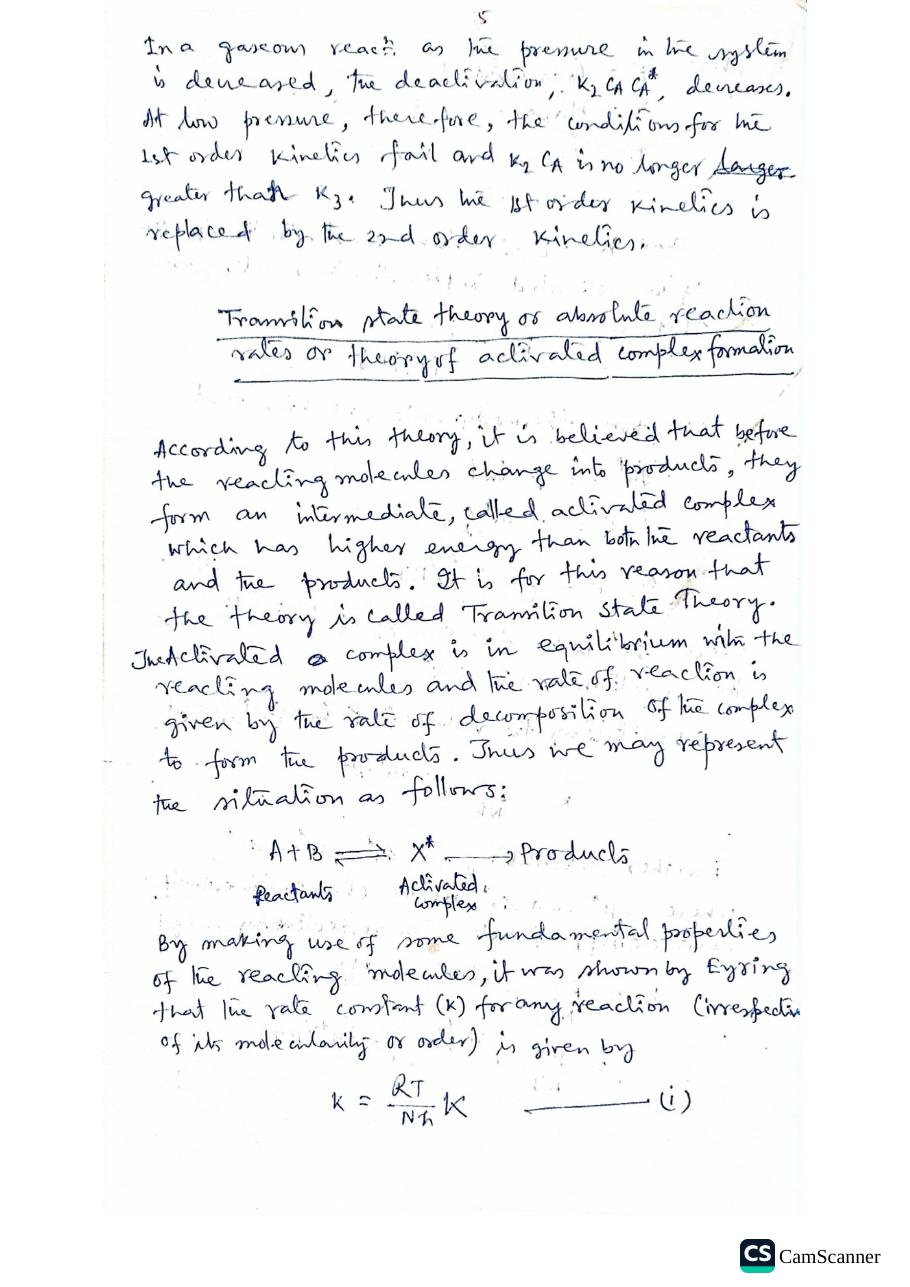
(i) When conc. of is very high then
This is a 1st order reaction.
(ii) In low conc.
This is a 2nd order reaction.
In a gaseous reaction as the pressure in the system is decreased, the deactivation, , decreases. At low pressure, therefore, the conditions for the 1st order kinetics fail and is no longer greater than (the notebook first wrote "larger", struck it through, and replaced it with "greater than"). Thus the 1st order kinetics is replaced by the 2nd order kinetics.
06 Transition-state theory: the activated complex
Transition state theory or absolute reaction rates or theory of activated complex formation. According to this theory, it is believed that before the reacting molecules change into products, they form an intermediate, called activated complex, which has higher energy than both the reactants and the products. It is for this reason that the theory is called Transition state Theory.
The activated complex is in equilibrium with the reacting molecules and the rate of reaction is given by the rate of decomposition of the complex to form the products. Thus we may represent the situation as follows:
Reactants Activated complex
07 Eyring's rate equation, steps i–iv
By making use of some fundamental properties of the reacting molecules, it was shown by Eyring that the rate constant for any reaction (irrespective of its molecularity or order) is given by
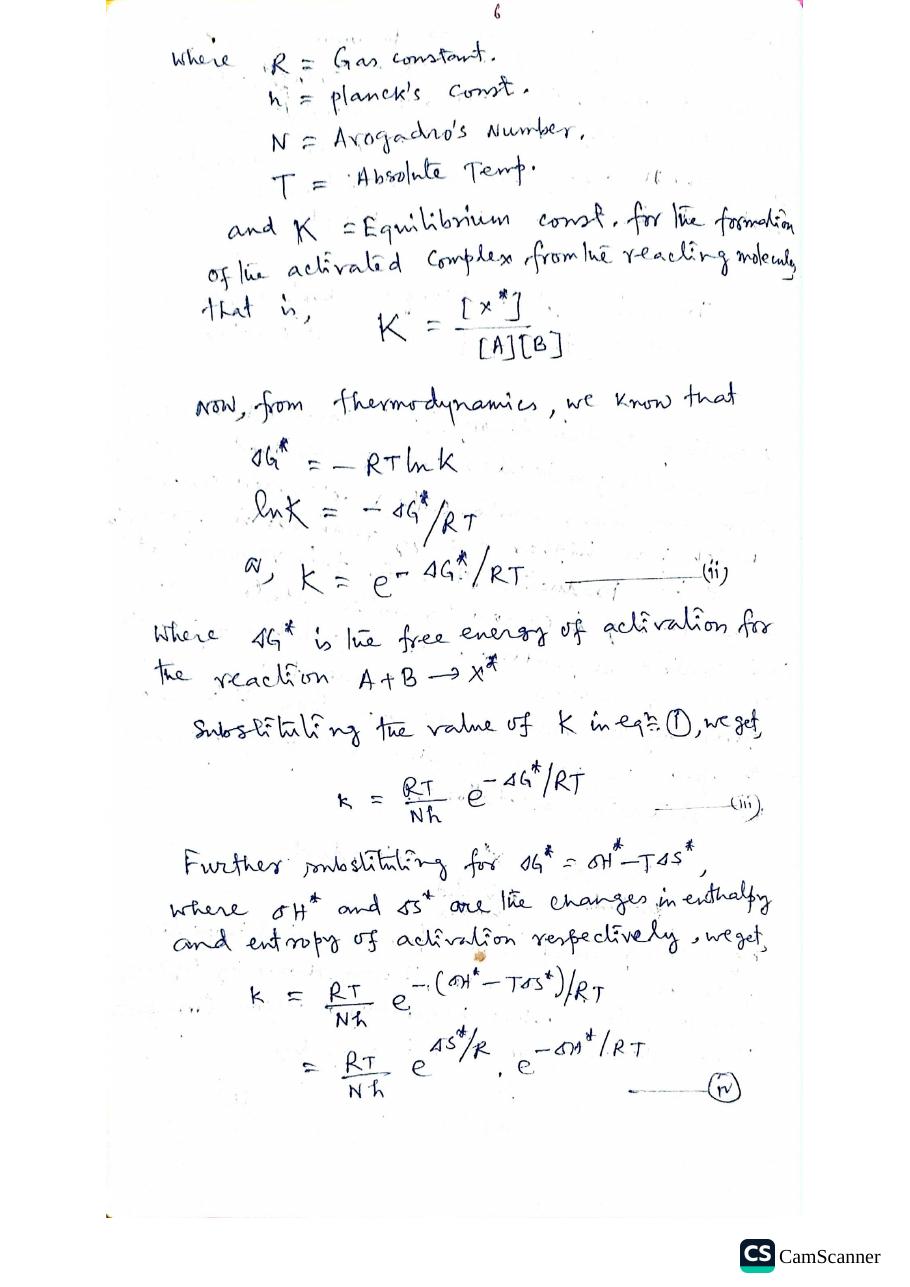
= gas constant; = Planck's const.; = Avogadro's Number; = absolute temp.; and = equilibrium const. for the formation of the activated complex from the reacting molecules, that is, .
Now, from thermodynamics, we know that
or,
where is the free energy of activation for the reaction .
Substituting the value of in eqn (i), we get
Further substituting for , where and are the changes in enthalpy and entropy of activation respectively, we get
08 Significance: ΔG* decides the rate
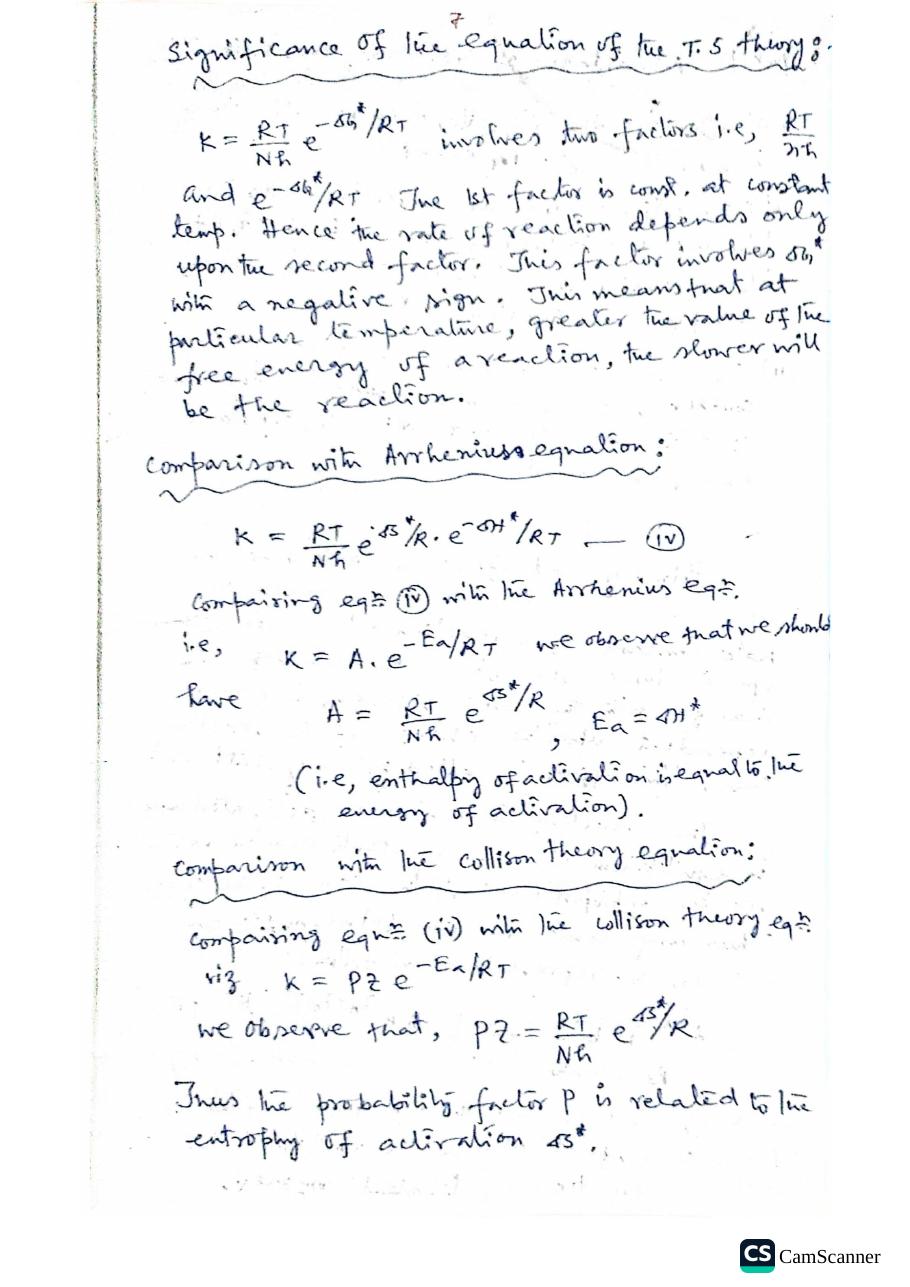
involves two factors i.e., and . The 1st factor is const. at constant temp. Hence the rate of reaction depends only upon the second factor.
This factor involves with a negative sign. This means that at particular temperature, greater the value of the free energy of activation of a reaction, the slower will be the reaction.
09 Comparison with the Arrhenius equation
Comparing eqn (iv) with the Arrhenius eqn. i.e., we observe that we should have
(i.e, enthalpy of activation is equal to the energy of activation).
10 Comparison with the collision theory
Comparing eqn (iv) with the collision theory eqn viz. we observe that,
Thus the probability factor is related to the entropy of activation .
11 Advantages of TST over collision theory
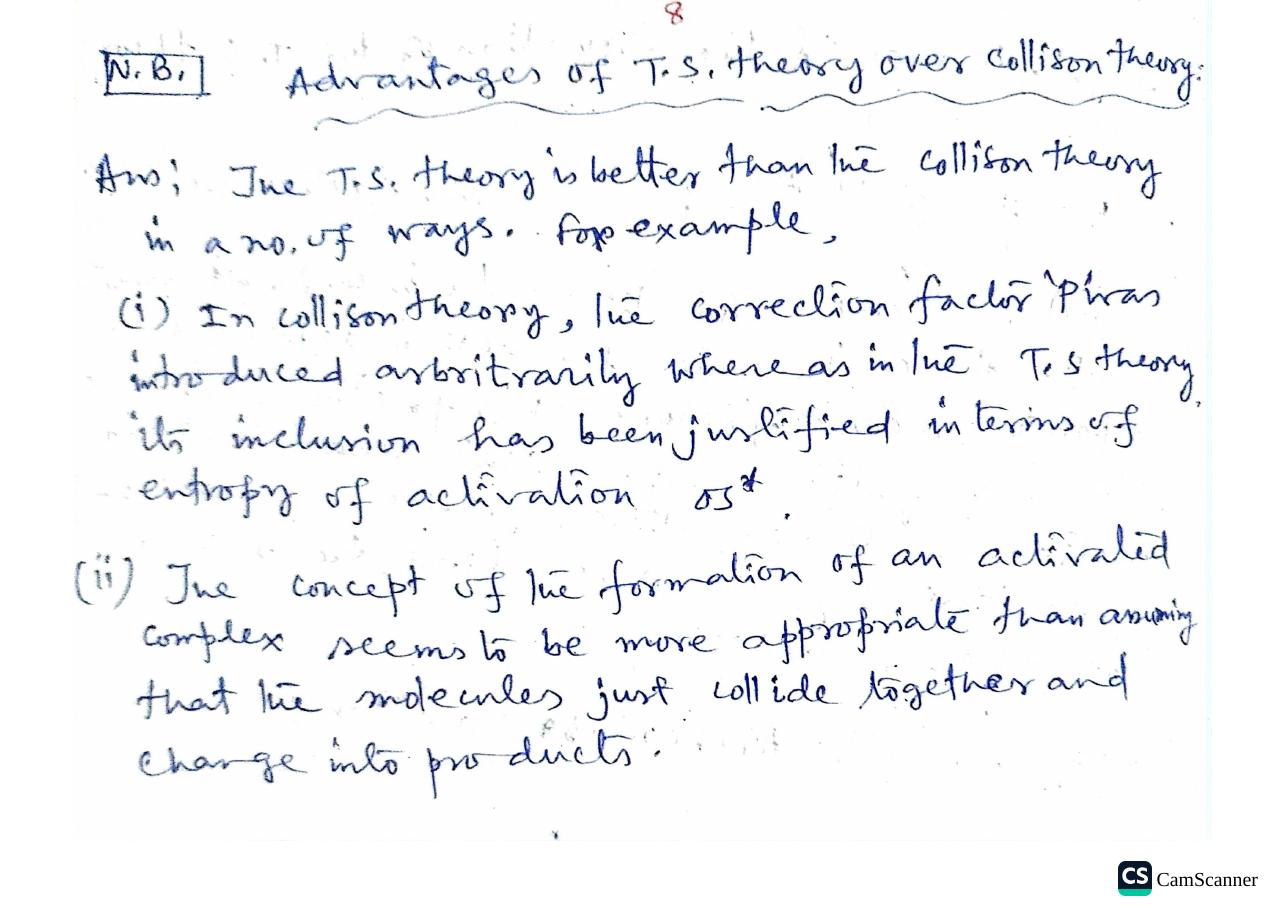
N.B. Advantages of T.S. theory over collision theory:
- (i) In collision theory, the correction factor was introduced arbitrarily, whereas in the T.S. theory its inclusion has been justified in terms of entropy of activation .
- (ii) The concept of the formation of an activated complex seems to be more appropriate than assuming that the molecules just collide together and change into products.
The two "mystery constants" of the earlier sections both dissolve: the steric factor turns out to be a disguised entropy term, and the Arrhenius pre-exponential turns out to be — thermodynamics all the way down.
12 The equation sheet, at a glance
Every boxed result of the lecture on one screen; labels match the sections above.
13 Symbol table
| Symbol | Meaning | Typical unit |
|---|---|---|
| Ordinary (non-activated) reactant molecules | — | |
| Activated / energized molecules | — | |
| Activated complex | — | |
| Number of collisions per c.c. per sec | cm⁻³ s⁻¹ | |
| Probability factor or steric factor | dimensionless | |
| Activation energy | J mol⁻¹ | |
| Lindemann rate constants (activation, deactivation, decomposition) | per step | |
| Equilibrium constant for activated-complex formation, | — | |
| Free energy, enthalpy, entropy of activation | J mol⁻¹; J mol⁻¹; J K⁻¹ mol⁻¹ | |
| Gas constant | 8.314 J mol⁻¹ K⁻¹ | |
| Avogadro's number | 6.022 × 10²³ mol⁻¹ | |
| Planck's constant | 6.626 × 10⁻³⁴ J s | |
| Absolute temperature | K | |
| Fraction of activated molecules | dimensionless |
14 Rapid revision — the lecture's chain
- Collision theory: reaction begins with molecular collision; rate ∝ collisions per unit time.
- Not every collision reacts: only those raising molecules to the activation-energy level are "effecting in causing chemical change".
- Activated fraction — the Boltzmann factor (translational energy, two degrees of freedom).
- —(i); for complex/large molecules, with steric factor .
- Lindemann (1922): activated molecules wait a finite time before decomposition; a second collision can deactivate them.
- Mechanism — arrows labelled , rates in : activation , deactivation , decomposition .
- Steady state → .
- High pressure (): — 1st order; low pressure (): — 2nd order.
- Lowering the pressure kills deactivation → 1st-order kinetics replaced by 2nd-order.
- TST: reactants form the activated complex in equilibrium; rate = rate of complex decomposition.
- Eyring (i) ; (ii) ; (iii) ; (iv) .
- Significance: is constant at fixed T — the rate depends only on ; larger ΔG*, slower reaction.
- vs Arrhenius: , .
- vs collision theory: — the probability factor is an entropy of activation in disguise.
- TST advantages: justified via instead of introduced arbitrarily; the activated complex is a more appropriate picture than bare collision.
15 Editor's notes — what the handwriting said
- The 1922 fix. Both copies write "Lindemann in 1992 proposed". Chemistry makes this unambiguous: F. A. Lindemann proposed the mechanism in 1922 — transcribed as 1922 everywhere; the handwriting reads 1992 in both documents.
- Equation numbering in the alternate copy (JPG 3). The writer crossed out "(iv)" and relabelled the Eyring equation "(i)"; the Arrhenius equation is marked "(ii)". Kept as written in the scan captions; the main copy's (i)–(iv) sequence is used throughout the page.
- "larger" → "greater than". In the pressure-effect paragraph the word "larger" is struck through and replaced by "greater than": "k2cA is no longer greater than k3".
- "introduced" → "justified". In the alternate copy's advantages point 1, "introduced" is crossed out and replaced by "justified": "ΔS* is justified".
- K/k notation preserved. The mechanism arrows on the main-copy page 4 are labelled with capital K1, K2, K3 while the rate equations use lowercase k1, k2, k3 — preserved exactly as written.
- N2O5 kept as written. The decomposition is given simply as N2O5(g) → NO2(g) + NO3(g) — stoichiometrically simplified — transcribed as written, no correction added.
16 Original notebook scans
Digitised from the class notebook of 27 September 2026 — eight CamScanner pages (main copy) plus the condensed 3-page alternate notebook copy. Every equation above was cross-checked against these pages. Tap any thumbnail to open the full scan.
 S1 · collision theory, Boltzmann factor, −dn/dt = z·e^(−E/RT) (i)
 S2 · steric factor P, boxed Rate = P·z·e^(−E/RT)
 S3 · Lindemann scheme, N2O5 example, time lag
 S4 · mechanism K1/K2/K3, steady-state derivation, rate law
 S5 · high/low pressure limits, 1st↔2nd order, pressure effect
 S6 · transition-state theory, activated complex, Eyring (i)
 S7 · eqns (ii)–(iii), ΔG* substitution, significance
 S8 · eqn (iv), Arrhenius & collision comparisons, advantages
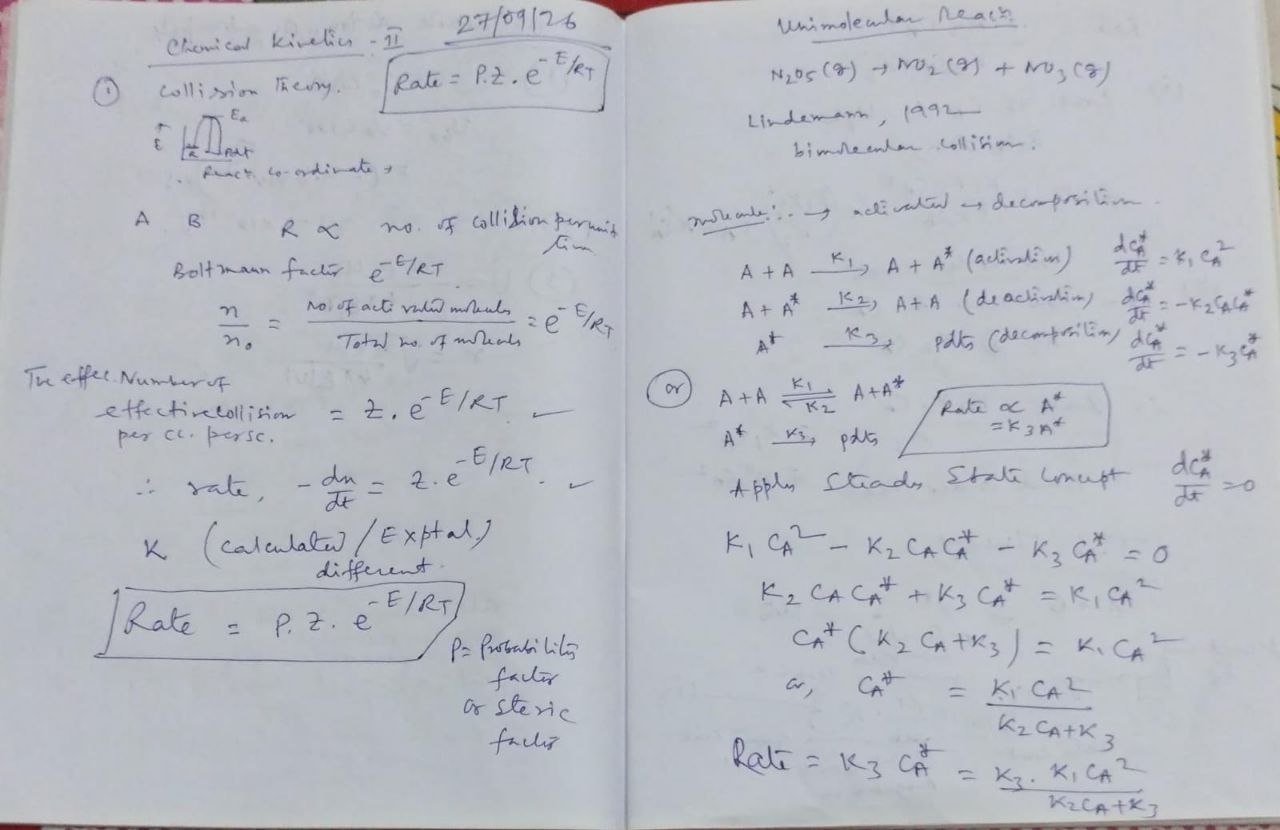 N1 · alternate copy p1 — condensed collision theory, energy diagram (E_a/"Act" peak)
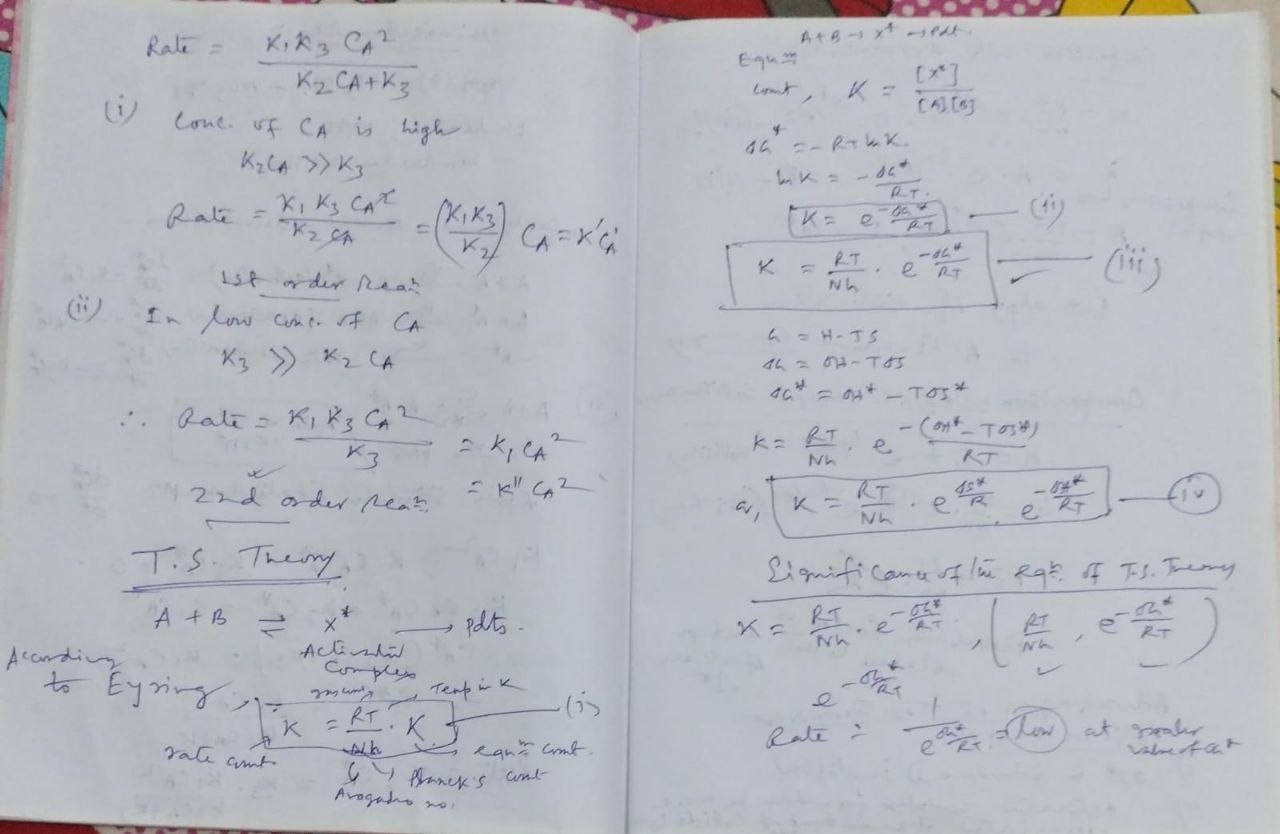 N2 · alternate copy p2 — condensed Lindemann, reversible arrows, boxed Rate ∝ A*
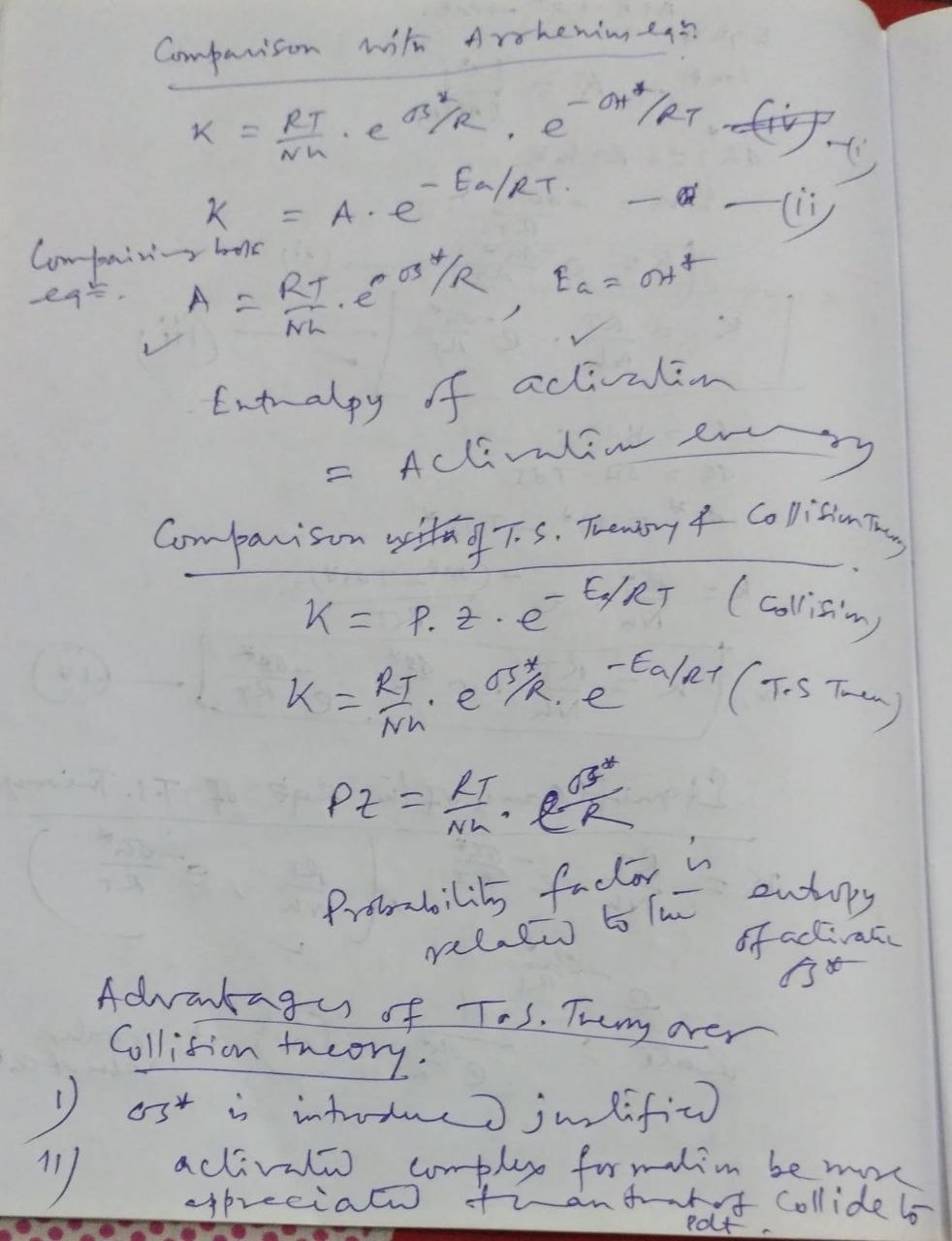 N3 · alternate copy p3 — Eyring (ii)–(iv), comparisons, advantages (crossed-out numbering)