00 Overview
Class 6 — lecture of 19 Sep 2026, fifteen scanned pages in two booklets — is a two-act class. Act I (four derivation pages) starts from Coulomb's law and nothing else, and builds the multipole expansion: the exact electrostatic potential of an ion sitting near a dipole, expanded term by term until the clean ion–dipole law drops out — then the same machinery applied to a planar quadrupole. Act II (eleven problem pages) is a pure problem set: twenty-three worked numericals on Born solvation, ion–dipole and ion–quadrupole energies, solvation thermodynamics, and ion-association constants.
— ion–ion, Coulomb's law (Sections 7).
— ion–dipole, Sections 1–2.
— ion–quadrupole, Sections 3–5.
Each extra multipole order costs one more power of distance — that is the whole moral of the multipole expansion, and Section 12 tables it.
- Sections 1–2 + lab derive the ion–dipole potential and the interaction energy .
- Sections 3–5 derive the ion–quadrupole potential and .
- Sections 6–12 the lecture's own twenty-three solved problems, worked in full.
- Sections 13–17 equation sheet, symbol table, rapid revision, editor's notes, raw scans.
01 Ion–dipole interaction: the geometry
Put an ion of charge on the -axis at , and a dipole along the same axis: charge at and charge at . The potential at an arbitrary point is the sum of the two Coulomb terms — and the entire derivation is just careful bookkeeping of the two distances.
The distance from the positive charge to :
where is the distance from the origin to (margin note). Factoring out :
Now the binomial expansion for , with :
Similarly for the negative charge, , and by the same calculation:
Nothing physical yet — only geometry plus the binomial theorem. The two expansions differ only in the sign of the term. That sign difference is the entire dipole: when the two Coulomb potentials are subtracted, everything else cancels and the dipole moment survives. Section 2 does the subtraction.
02 Ion–dipole potential and interaction energy
The potential at is the sum of the two charge contributions, :
The constant and terms cancel (crossed out in the notebook), leaving the boxed dipole potential:
The interaction energy of the ion in this potential is :
The potential of a dipole falls as — one power faster than a bare charge — and the interaction energy carries the dipole's charge separation explicitly. The condition is where the binomial expansion was legal: the field point must be far compared with the dipole's own size.
⊕ Lab · the dipole's orientation
The lecture gave you the sign of the answer — angle 0° = attraction, 180° = repulsion — but not the feeling of it. Spin the water molecules yourself: a lone Na⁺ has no chemistry of its own, yet it rotates five polar molecules into a hydration shell. Each oxygen points its negative end at the ion; flip the field and the molecules flip with it.
Watch water pick a side
One ion, six water molecules. Flip the charge and watch every dipole re-aim itself — this lock-in is the ion–dipole interaction of Section 1.
Amber = O (δ−), cyan = H (δ+). The alignment is electrostatic and permanent on average — that ordering of solvent is exactly why ΔSsolv < 0 (Section 7) and why the Eley–Evans inner term is negative (Class 2, Section 5).
03 Ion–quadrupole interaction: the setup
Now the dipole is replaced by a planar quadrupole: two positive charges placed symmetrically at along the -axis, and two negative charges at along the perpendicular axis. An ion of charge sits on the -axis at . By symmetry (ion to the two charges) and (ion to the two charges) — so only two distances need expanding.
The notebook finds the distances by a "transverse projection" construction (boxed in the original):
04 Expanding and
The quadrupole needs one more order than the dipole did: the expansion of is carried to the term, higher terms neglected.
With :
The notebook shows the intermediate algebra: , which collects to the form above. Similarly, with :
05 Quadrupole potential and interaction energy
Two charges at distance and two at give the potential (the notes call this "potential energy" ; the interaction energy follows as ):
The and terms cancel (crossed out in the notebook):
Multiplying by the ion charge and writing the dipole moment :
A quadrupole is the next multipole after the dipole, and its potential properly falls as — but this planar charge arrangement also carries a net dipole moment , whose contribution dominates at large . The pure quadrupole piece is the second term, proportional to the asymmetry .
06 The lecture's solved problems — Born solvation (1–4)
The second booklet is a pure problem set. Reproduced in full, arithmetic checked. Constants used throughout: , , .
Q. Calculate the solvation energy of an ion of charge +1 and radius in water ().
Ans. Given , . The molar Born equation:
Q. Two ions have the same radius, but charges , . Find the ratio of their Born solvation energies.
Ans. , so and :
The +2 ion has four times the magnitude of Born solvation energy.
Q. For two singly charged ions in the same solvent: , . Calculate .
Ans. :
The smaller ion has twice the magnitude of solvation energy.
Q. An ion has , and its solvation energy in a solvent is . Estimate the dielectric constant .
Ans.
A barely-polar solvent: with εr ≈ 1 there is almost no dielectric stabilisation, so even a modest |ΔG| forces εr down to ~1.
07 Solved problems — ion–ion & ion–dipole energy (5–6)
Q. Calculate the electrostatic interaction energy between two ions , , in water (), and the interaction energy per mole.
Ans.
Q. The ion–dipole energy is . For maximum interaction (). Given , , , : calculate , and the interaction energy in water.
Ans. , so :
In a dielectric medium :
08 Solved problems — solvation thermodynamics & hydration number (7–8)
Q. For an ion–solvent interaction, ; . Calculate at 298 K.
Ans. , with :
Q. For an ion–solvent interaction: , , . Calculate .
Ans. :
09 Solved problems — ion association & Ka (1–8)
For the equilibrium , . For a 1:1 electrolyte of total concentration with fraction dissociated : .
Q. For : , , . Calculate .
Q. , , . Calculate .
Q. , , . Calculate the free ion concentration .
Q. A 1:1 electrolyte has , . If is the fraction dissociated, calculate .
Percentage dissociation = 61.8%; percentage association = 38.2%.
Q. A 1:1 electrolyte has concentration . The degree of association . Calculate .
Ans. Ion-pair conc. ; free ion conc. :
Q. For a 1:1 electrolyte, , . Calculate the association constant.
Q. For a 1:1 electrolyte, ; at a particular concentration , . Calculate .
Ans. :
Q. Two electrolytes have association constants and . Which has stronger ion association?
Ans. A higher means the equilibrium lies further toward ion-pair formation. Since 500 > 10, the second electrolyte has much stronger ion association.
⊕ Lab · the pairing window
Eight association problems computed Kₐ for fixed constants — this lab answers the prior question: when should ions pair at all? Bjerrum's length is the distance where the Coulomb energy equals k_BT; below it, the electrostatic pull beats thermal motion and ion pairs win. Push the dielectric up to 78.5 and watch the pairing window collapse — that is why water dissociates salts.
How wide is the pairing window?
The green band is the association region a ≤ r ≤ r_B drawn to scale. Cool the solution, drop the dielectric constant, or raise the charge product — and watch the window open.
Sanity value: water (ε = 78.5) at 298 K, 1:1 electrolyte → r(B) ≈ 7.1 Å, the textbook number. Wider window = more separations count as associated = larger K(A) (Sections 7–8).
10 Solved problems — ion–dipole angle & distance (1–3)
Q. An ion–dipole system has . Calculate the interaction energy when .
Q. For an ion–dipole system: . Calculate when .
Positive energy indicates repulsion for this orientation.
Q. An ion and dipole have maximum attractive interaction energy . Given , . Find in vacuum.
Ans. , so ; :
11 Solved problems — ion–quadrupole (4–6)
Q. An ion with interacts with a molecule having quadrupole moment at . Calculate for axial orientation in vacuum.
Q. For an ion–quadrupole interaction: at . Calculate when .
Ans. :
Q. Two ions interact with the same quadrupole at the same distance. Ion 1: , . Calculate for .
Ans. :
12 How the interaction energy changes with distance
Q. Suppose . How does the interaction energy change for ion–dipole and ion–quadrupole interaction?
Ans. For ion–dipole, :
For ion–quadrupole, :
For ion–dipole , hence .
For ion–quadrupole , hence .
| Interaction | Distance dependence |
|---|---|
| (i) ion–ion | |
| (ii) ion–dipole | |
| (iii) ion–quadrupole |
13 The equation sheet, at a glance
Every boxed result of the lecture on one screen; labels match the sections above.
14 Symbol table
| Symbol | Meaning | First seen |
|---|---|---|
| charge of the ion (+Zie) | §1 | |
| dipole charges and half-separation | §1 | |
| field point; distance OP | §1 | |
| distances +q→P, −q→P | §1 | |
| electrostatic potential | §2 | |
| interaction energy | §2 | |
| quadrupole half-separations (+q, −q) | §3 | |
| distance −q→ion | §3 | |
| quadrupole potential | §5 | |
| dipole moment, | §5 | |
| molecular dipole moment (problems) | §7 | |
| quadrupole moment (problems) | §11 | |
| ion-association constant | §9 | |
| fraction dissociated | §9 | |
| hydration (solvation) number | §8 | |
| molar conductivity | §9 |
15 Rapid revision
- The whole derivation is geometry + binomial expansion: write and as series in the small ratio (dipole size)/(field distance), subtract — only the dipole term survives.
- Ion–dipole: , , valid for .
- Ion–quadrupole: expand one order further (); .
- Distance ladder: ion–ion → ion–dipole → ion–quadrupole — each multipole order costs one power of .
- Born: — charge matters as the square, size inversely.
- Association: ; conductivity gives .
- Orientation: — maximum attraction at , repulsion at .
- Doubling the distance quarters an ion–dipole energy and eighths an ion–quadrupole energy.
16 Editor's notes
Uncertainties flagged in the transcription, resolved with chemistry sense — nothing else was changed.
- Heading reconstruction: the top heading of derivation page 1 is cropped at the scan edge ("Ion Dipole Interac…"); restored as "Ion–Dipole Interaction" from the visible remainder and content.
- Charge exponent: the elementary charge was written as in Solv. 5; corrected to — the value is stated explicitly on the first problem page and the worked answer requires it.
- Illegible glyph: an unreadable symbol between "−500" and "J mol⁻¹" in Solv. 4 was dropped; the calculation is unaffected.
- Illegible salt name: the compound name before ΔHsolv in Solv. 7 could not be read; the problem is stated for a generic ion–solvent interaction.
- Inferred unit: the distance in M.P. 4 is cut off at the page edge ("r = 0.3…"); nm was inferred from the worked calculation .
- Quadratic sign: in Assoc. 4 the sign before the 1 in looks corrected in the handwriting; the algebra and the stated root confirm it.
- Notation kept as written: the notes use for the electrostatic potential and call the "potential energy"; transcribed verbatim.
17 Original notebook scans
Digitised from the class notebook of 19 Sep 2026 — two CamScanner booklets: four derivation pages (S1–S4, scanned 00:17) and eleven problem pages (S5–S15, scanned 00:22). Every equation above was cross-checked against these pages, and every numerical re-computed. Tap any thumbnail to open the full scan.
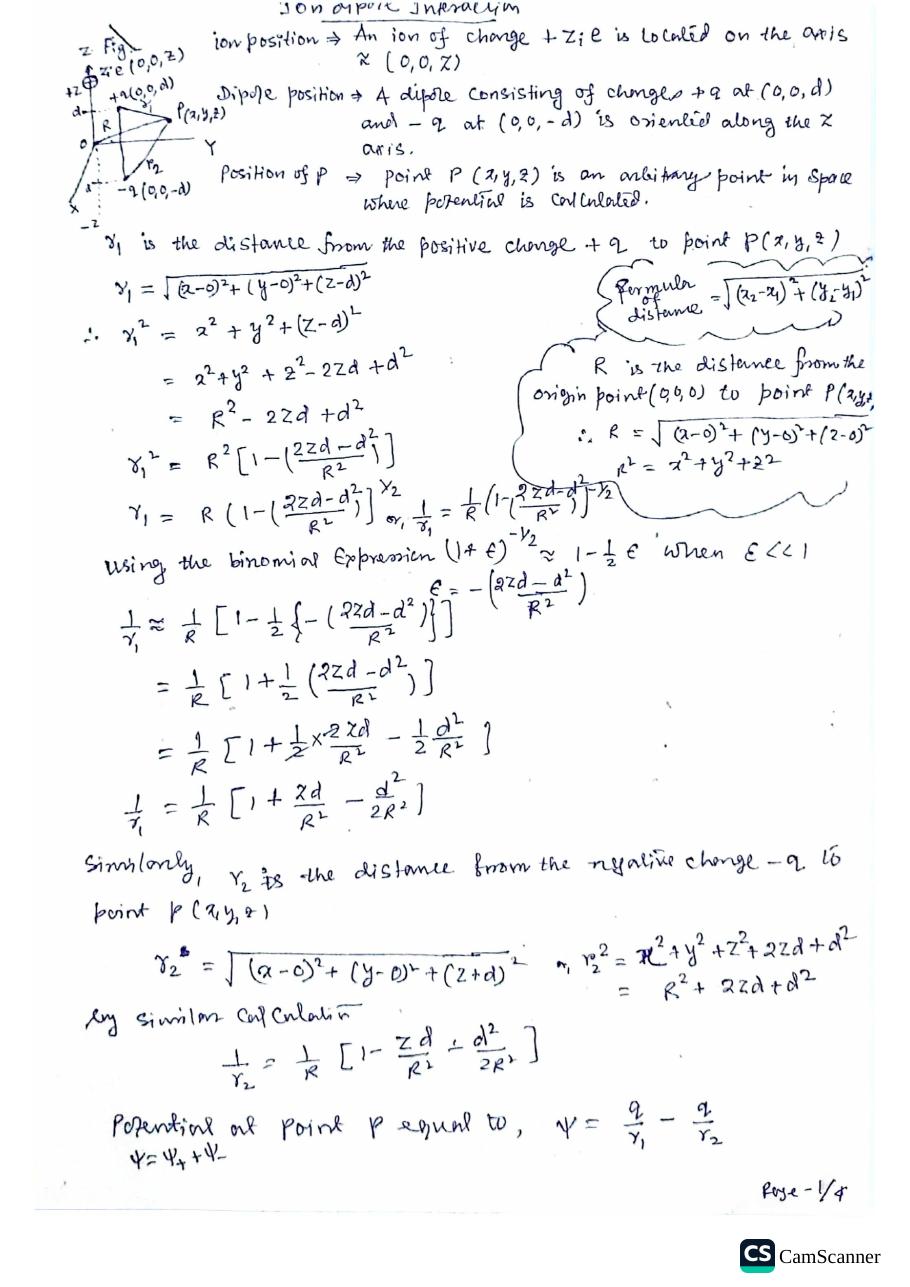 S1 · ion–dipole geometry, 1/r₁ expansion
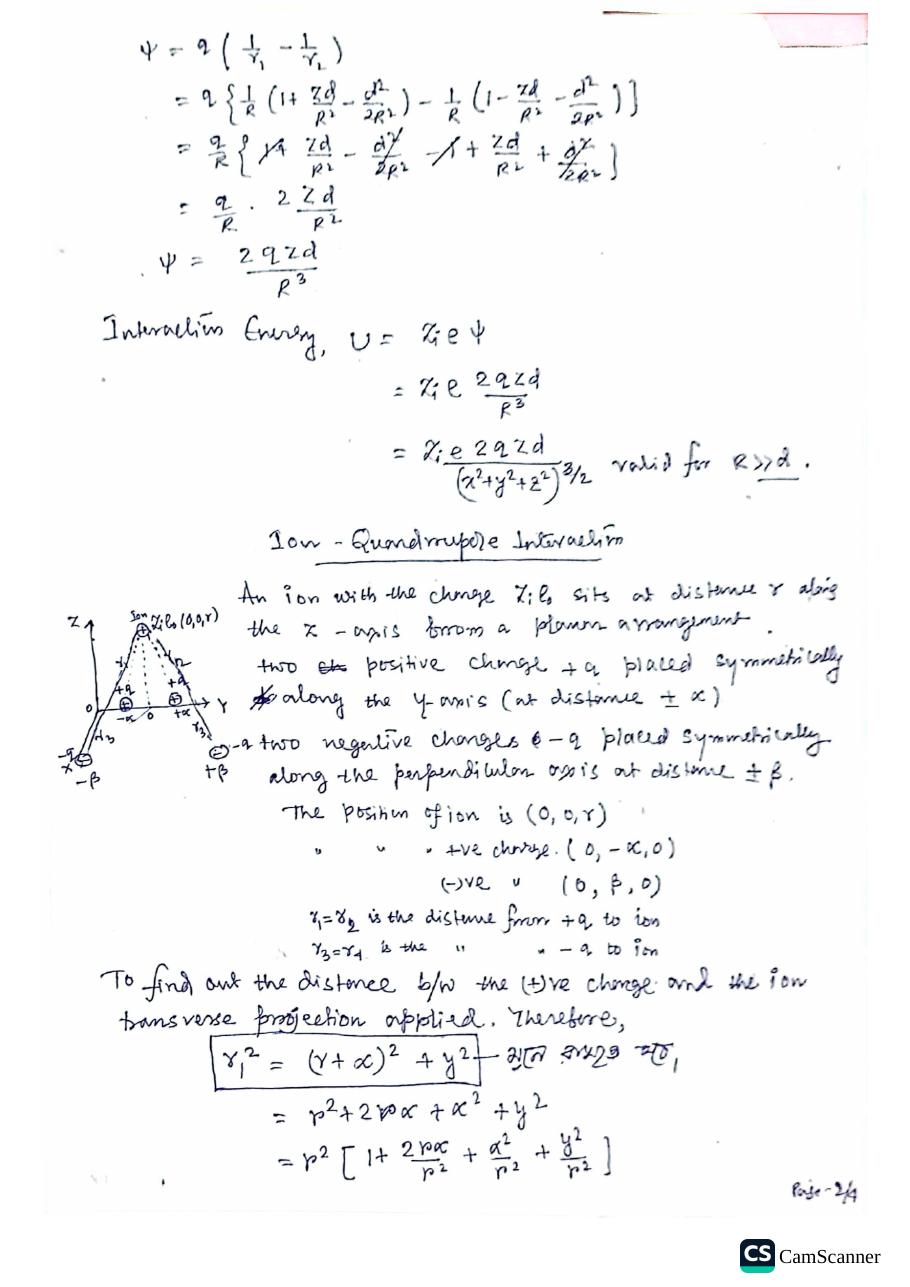 S2 · ion–dipole potential ψ = 2qzd/R³, quadrupole setup
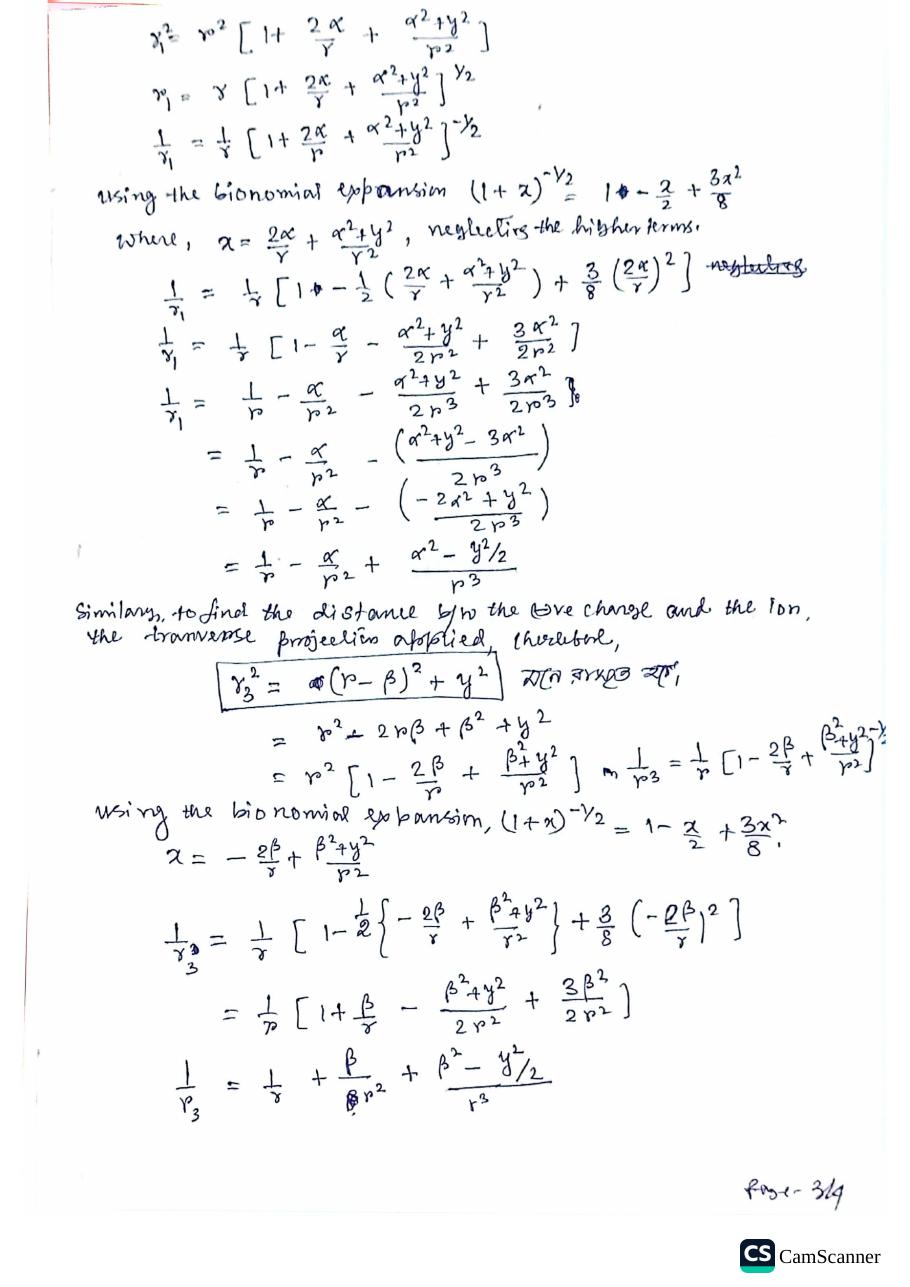 S3 · expanding 1/r₁ and 1/r₃
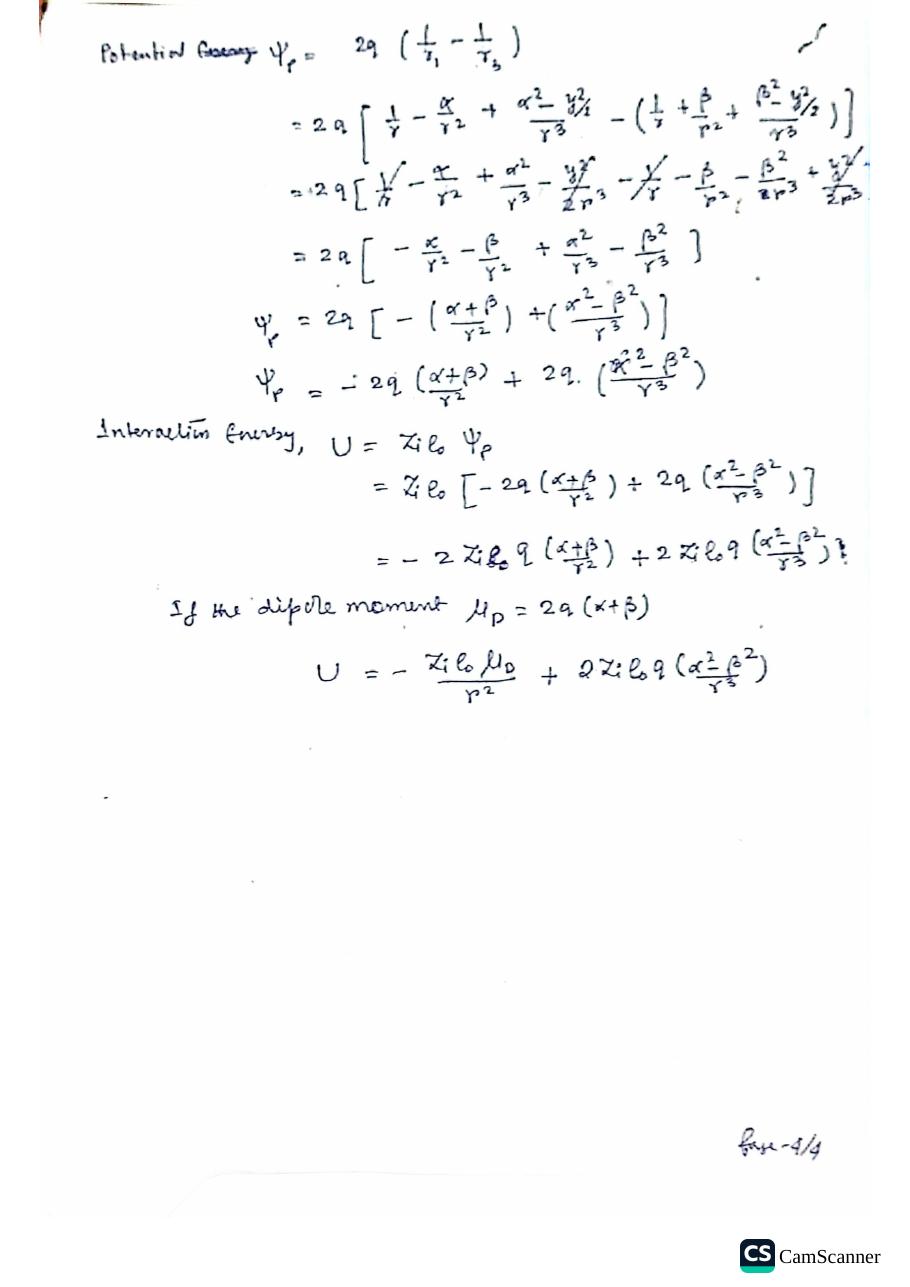 S4 · quadrupole potential ψ(p), interaction energy U
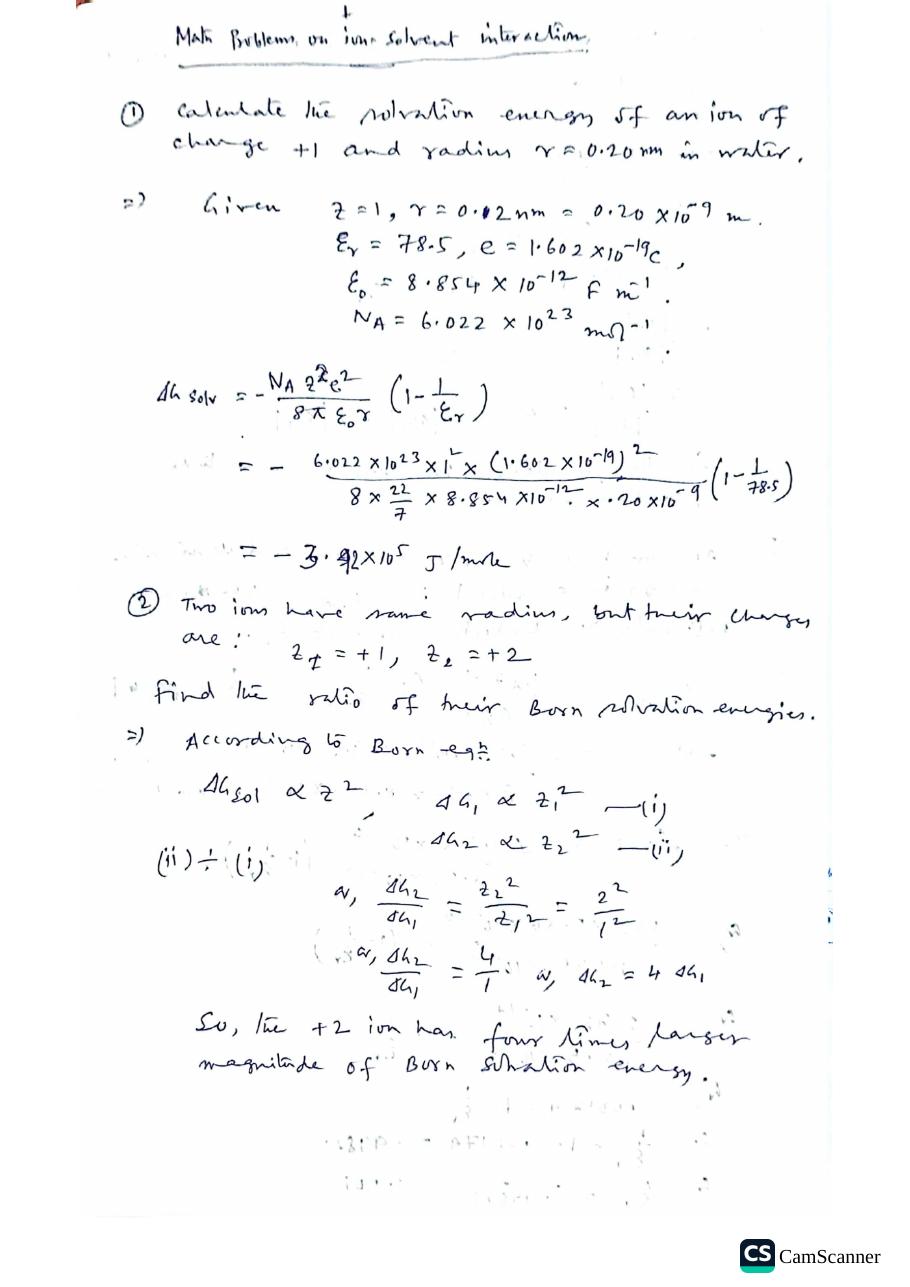 S5 · Solv. 1–2 (Born solvation)
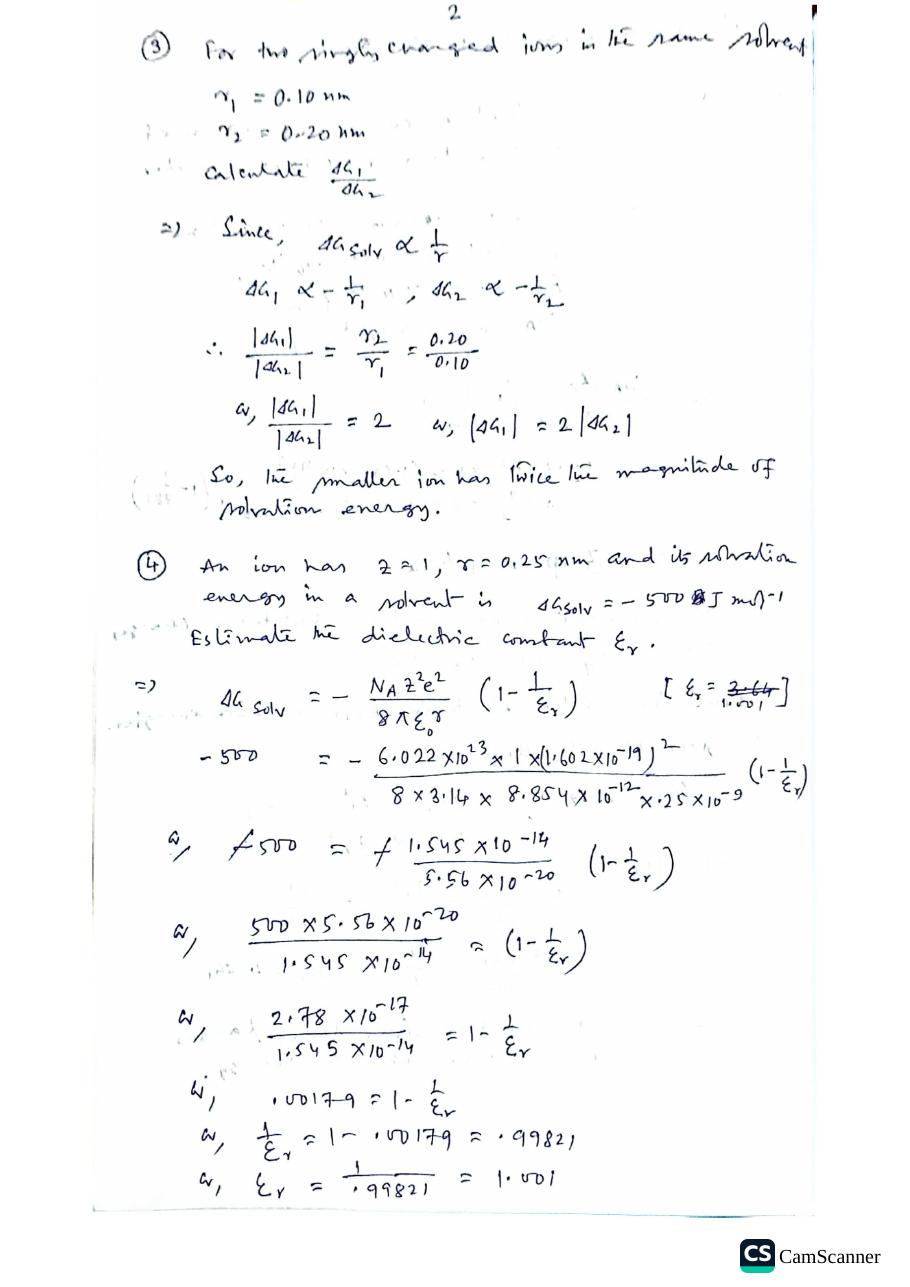 S6 · Solv. 3–4 (Born ratios, ε from ΔG)
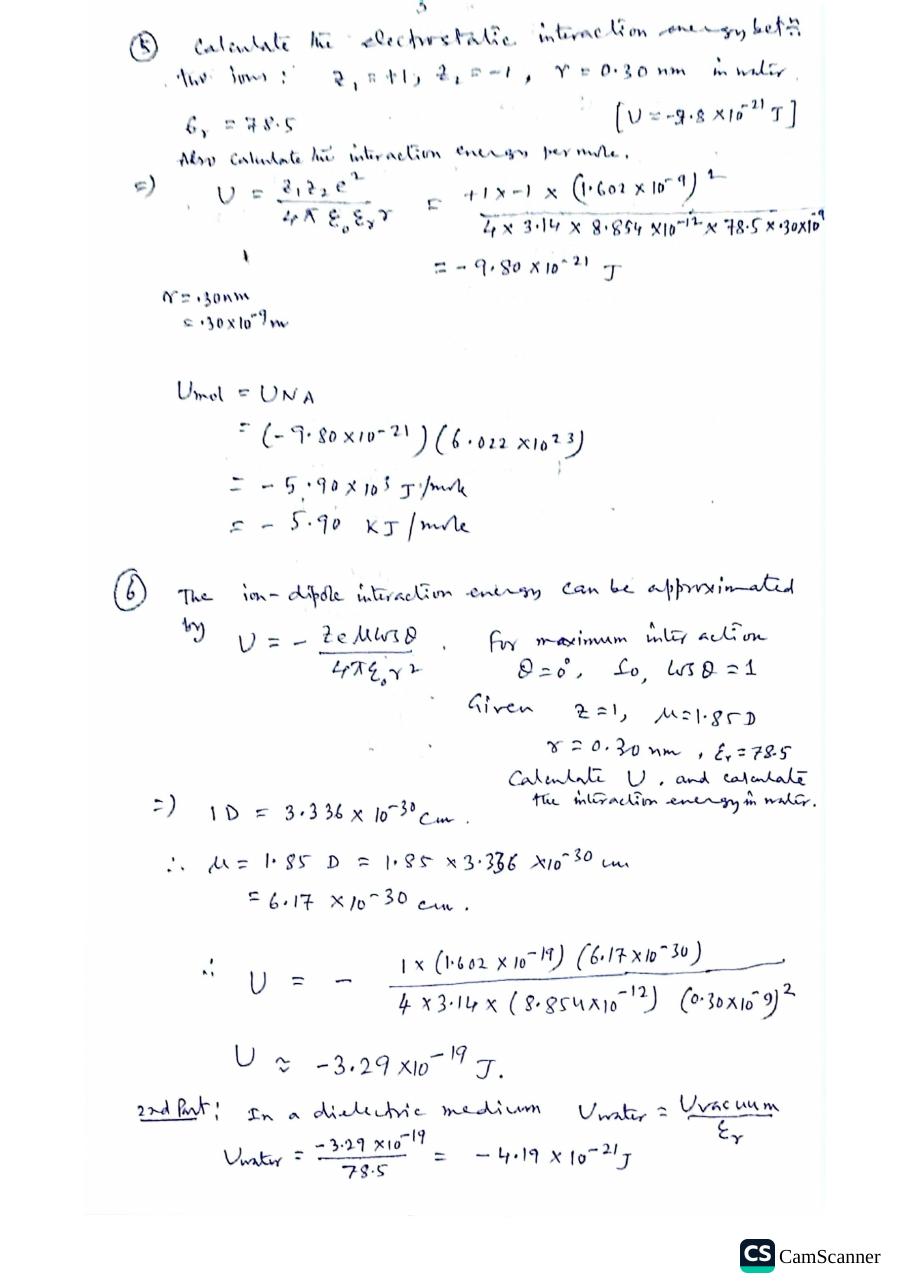 S7 · Solv. 5–6 (ion–ion, ion–dipole energy)
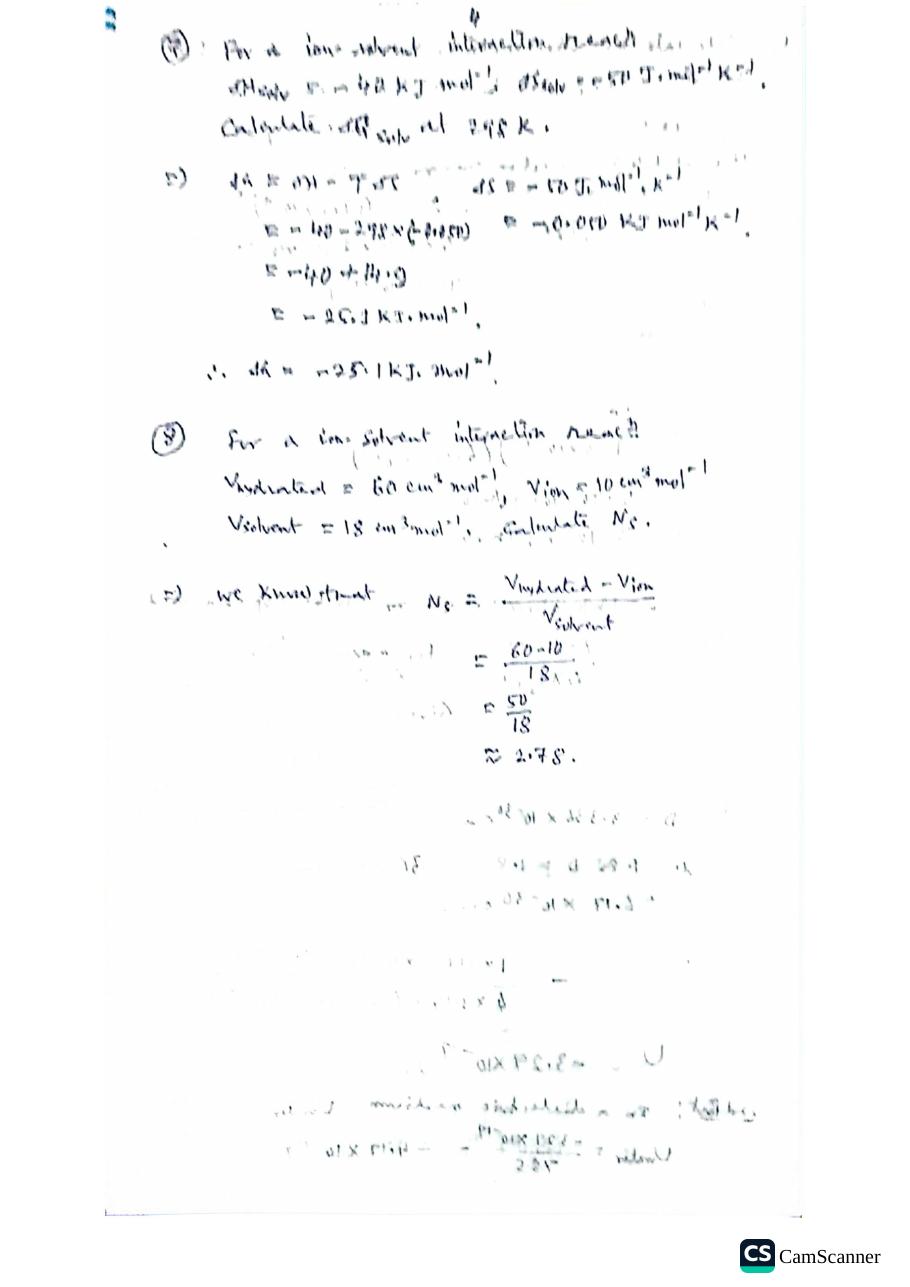 S8 · Solv. 7–8 (ΔG from ΔH/ΔS, hydration number)
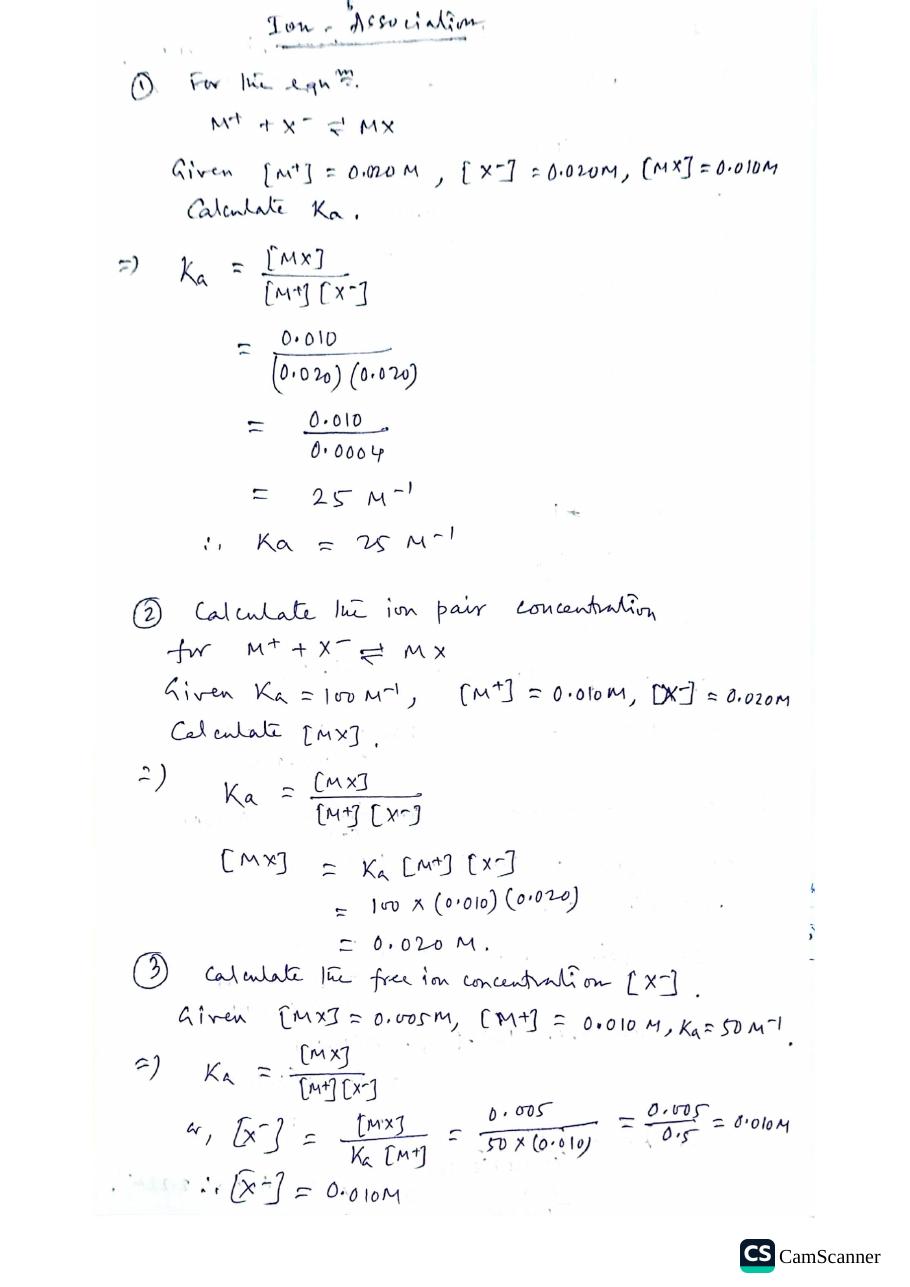 S9 · Assoc. 1–3 (Kₐ from concentrations)
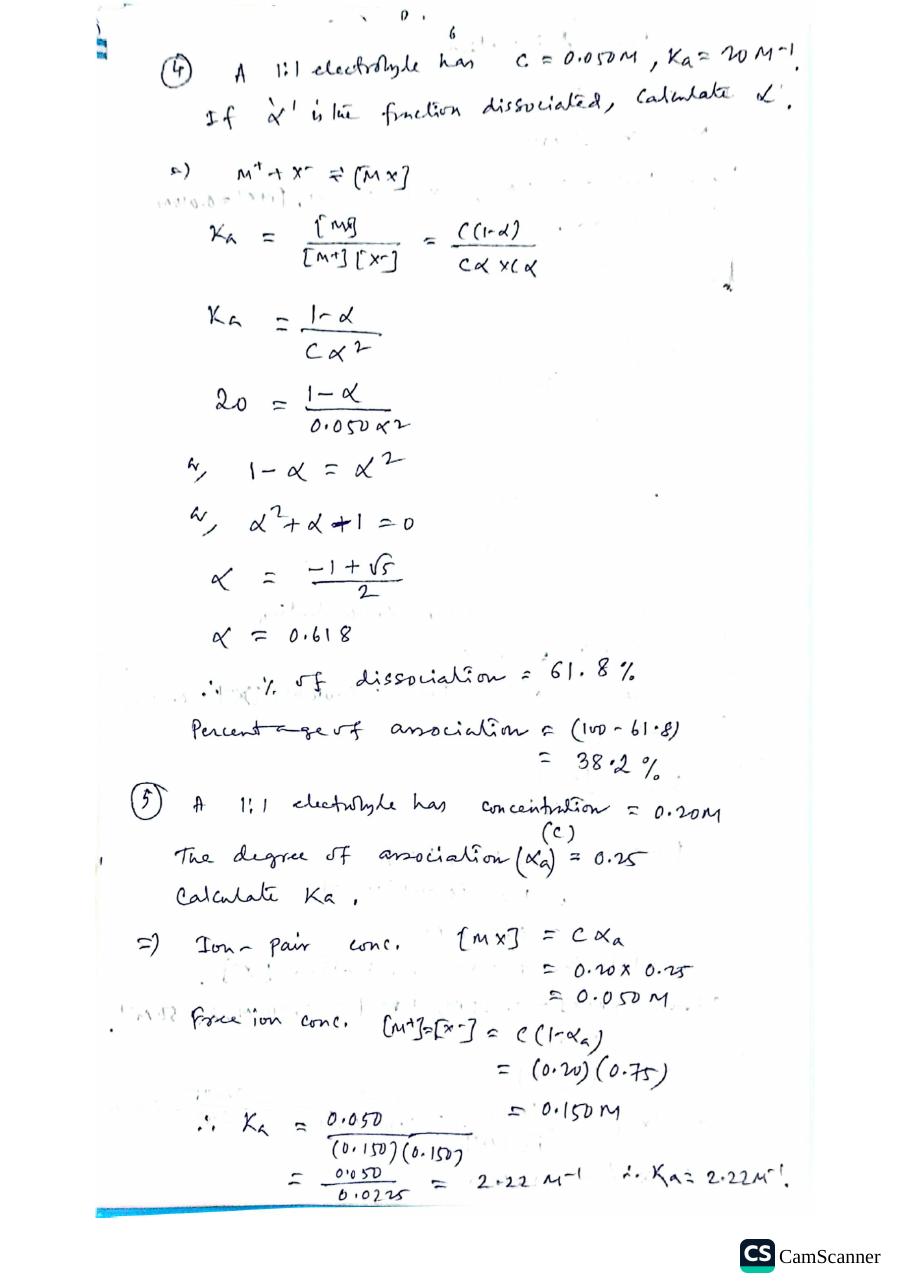 S10 · Assoc. 4–5 (α from Kₐ, Kₐ from αₐ)
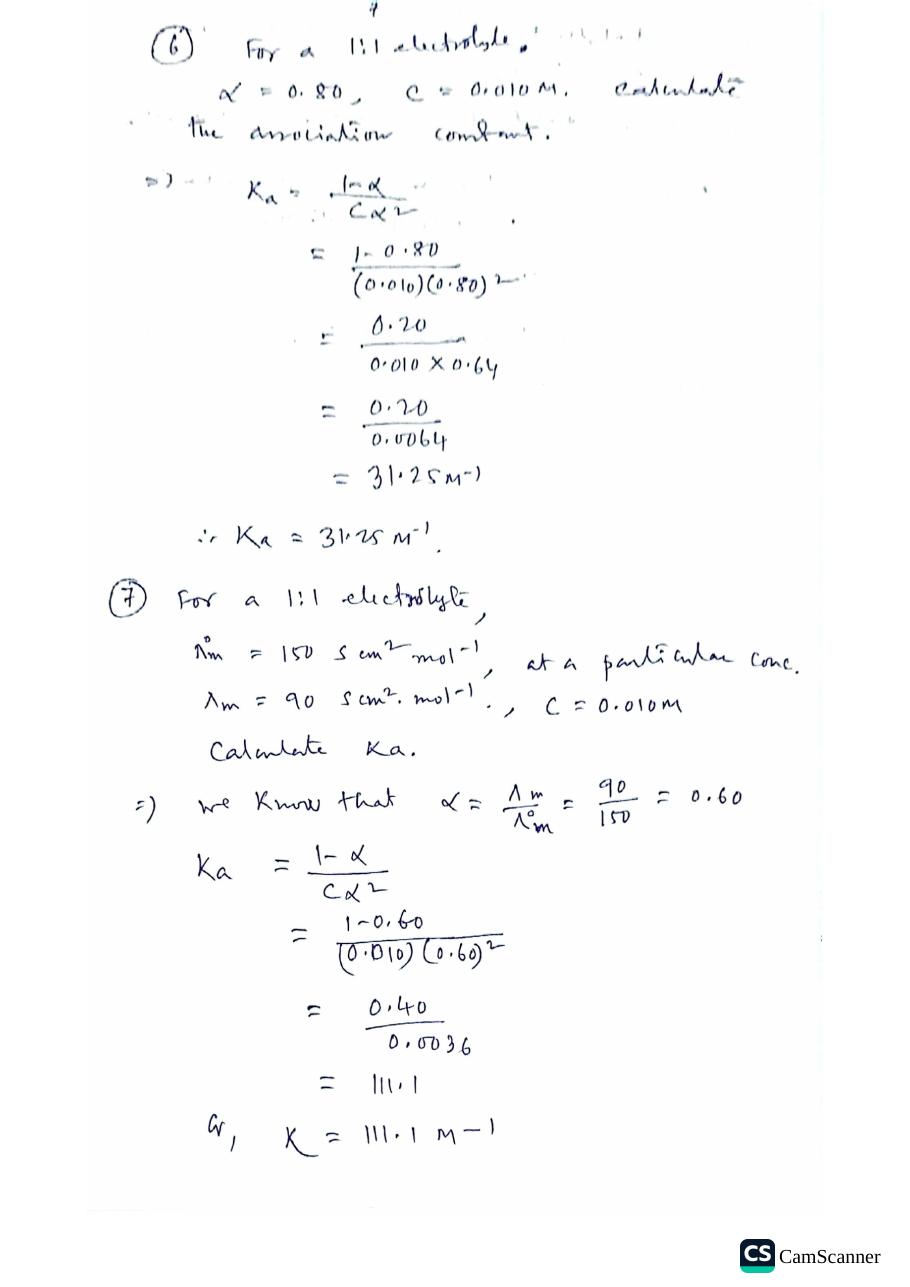 S11 · Assoc. 6–7 (Kₐ from α, from conductivity)
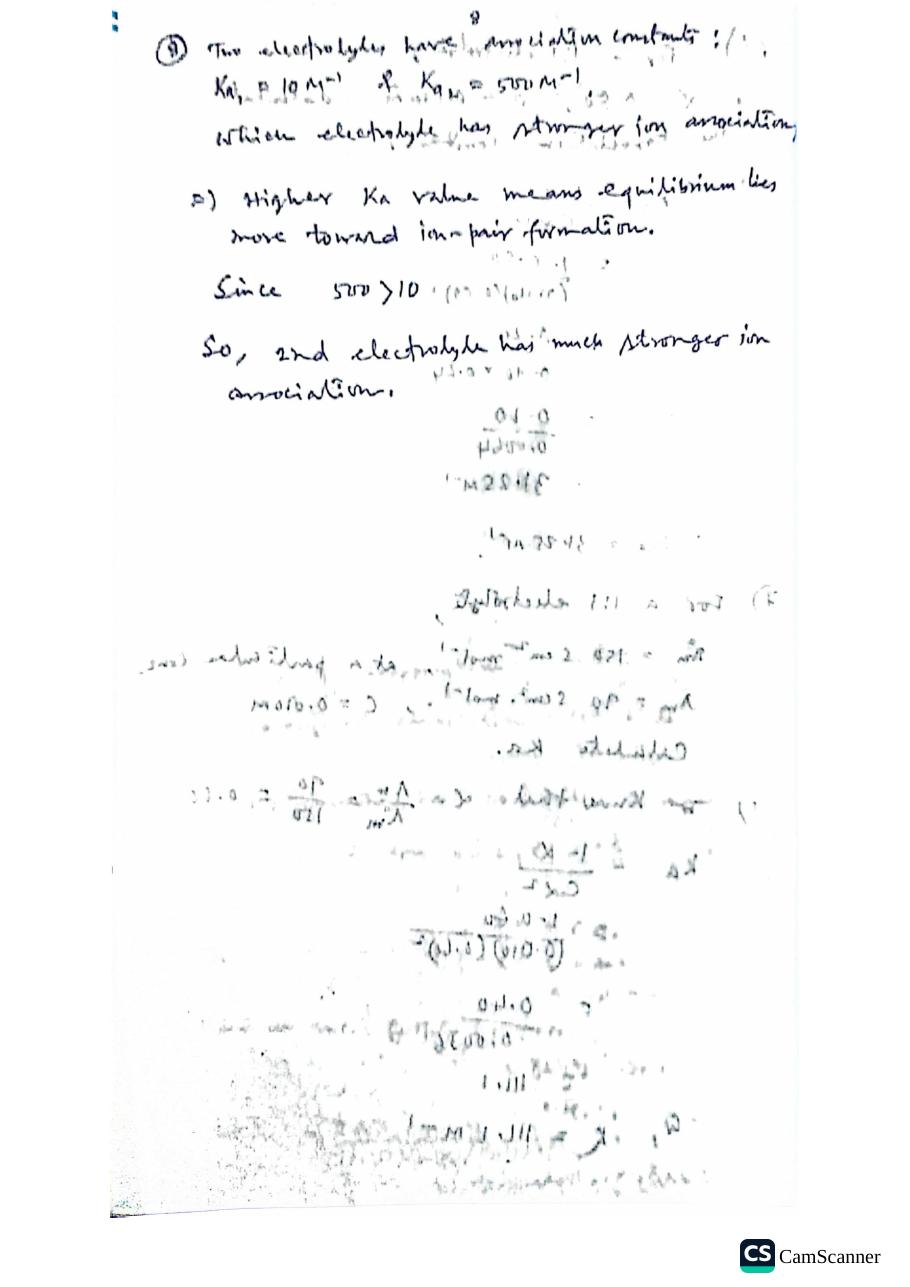 S12 · Assoc. 8 (comparing association)
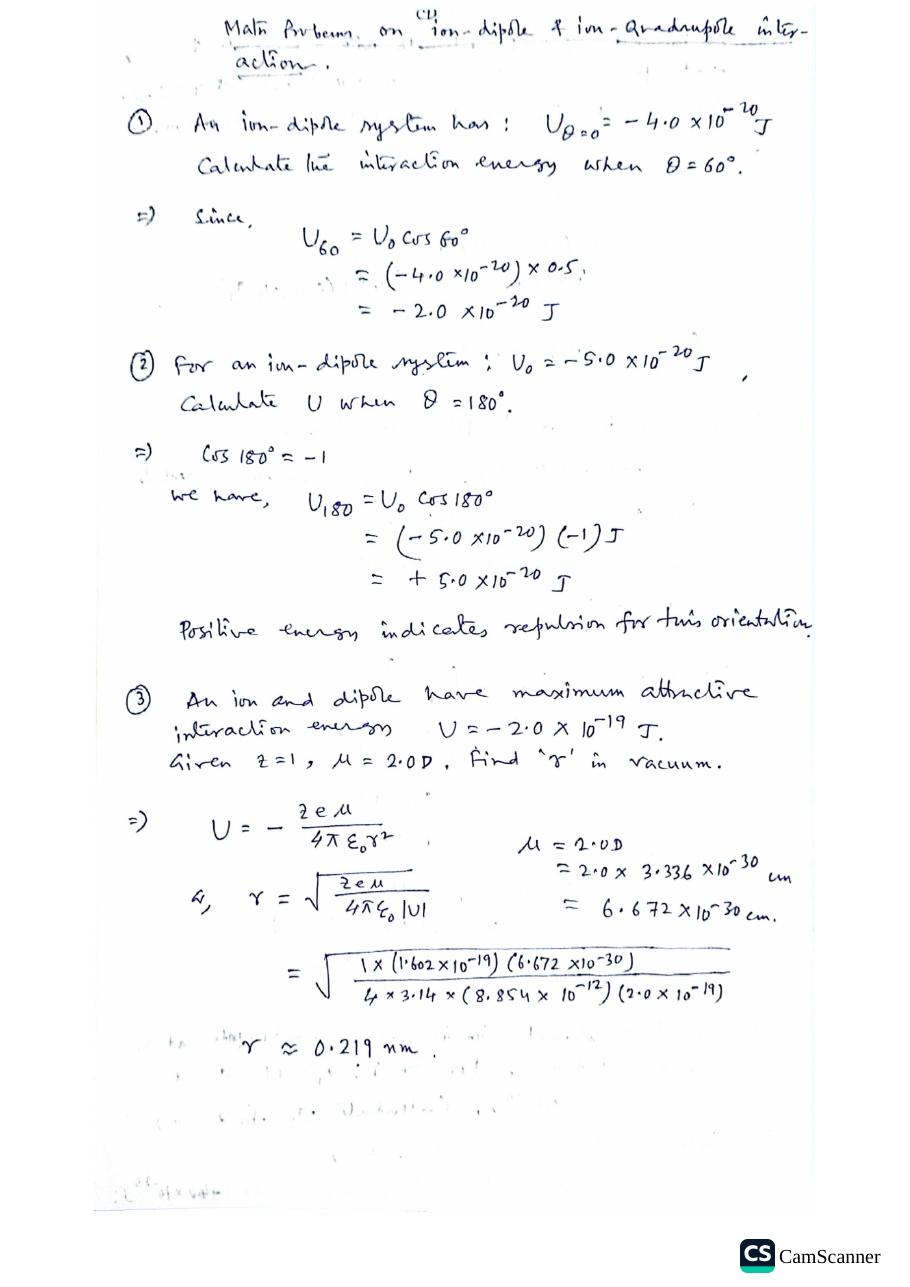 S13 · M.P. 1–3 (ion–dipole angle & distance)
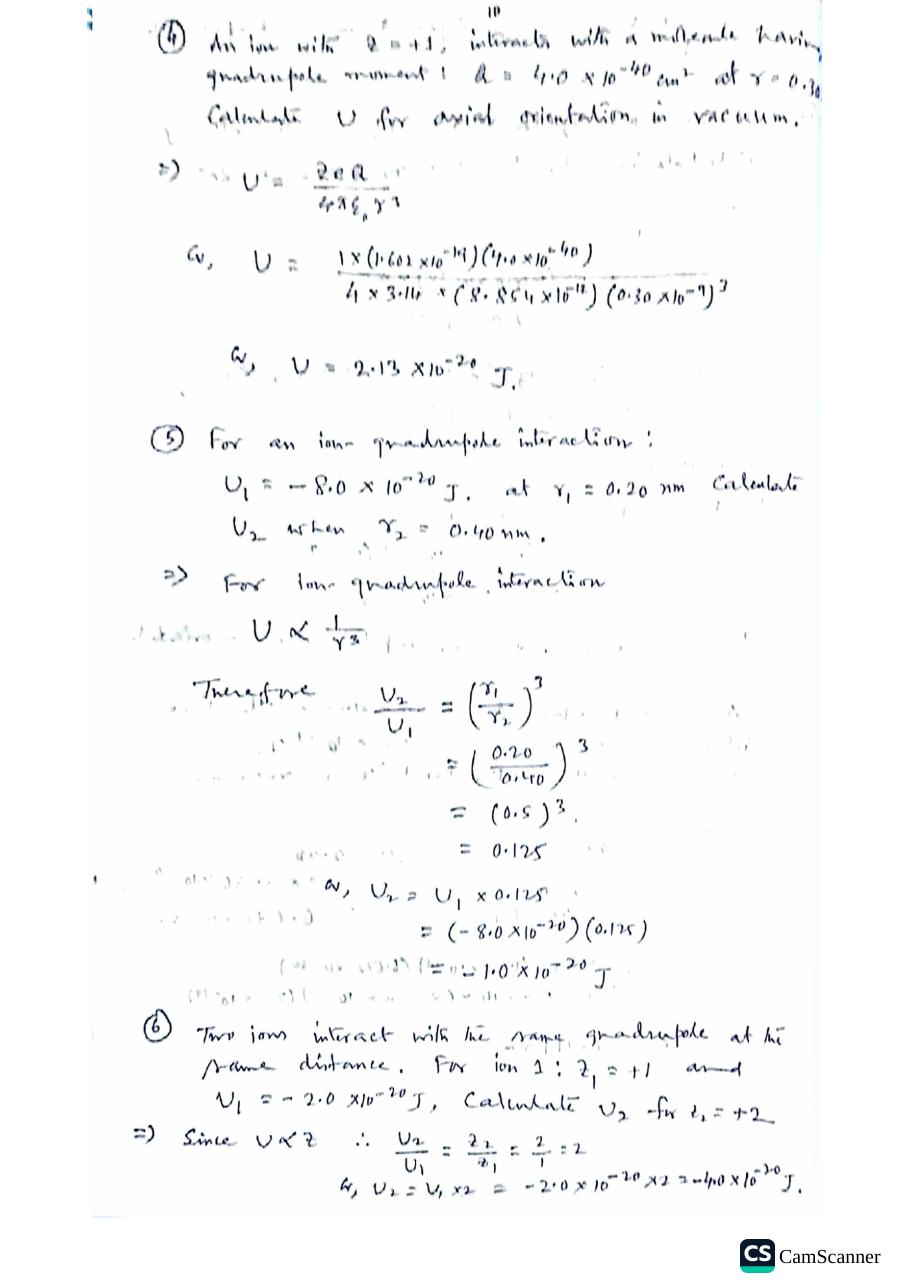 S14 · M.P. 4–6 (ion–quadrupole)
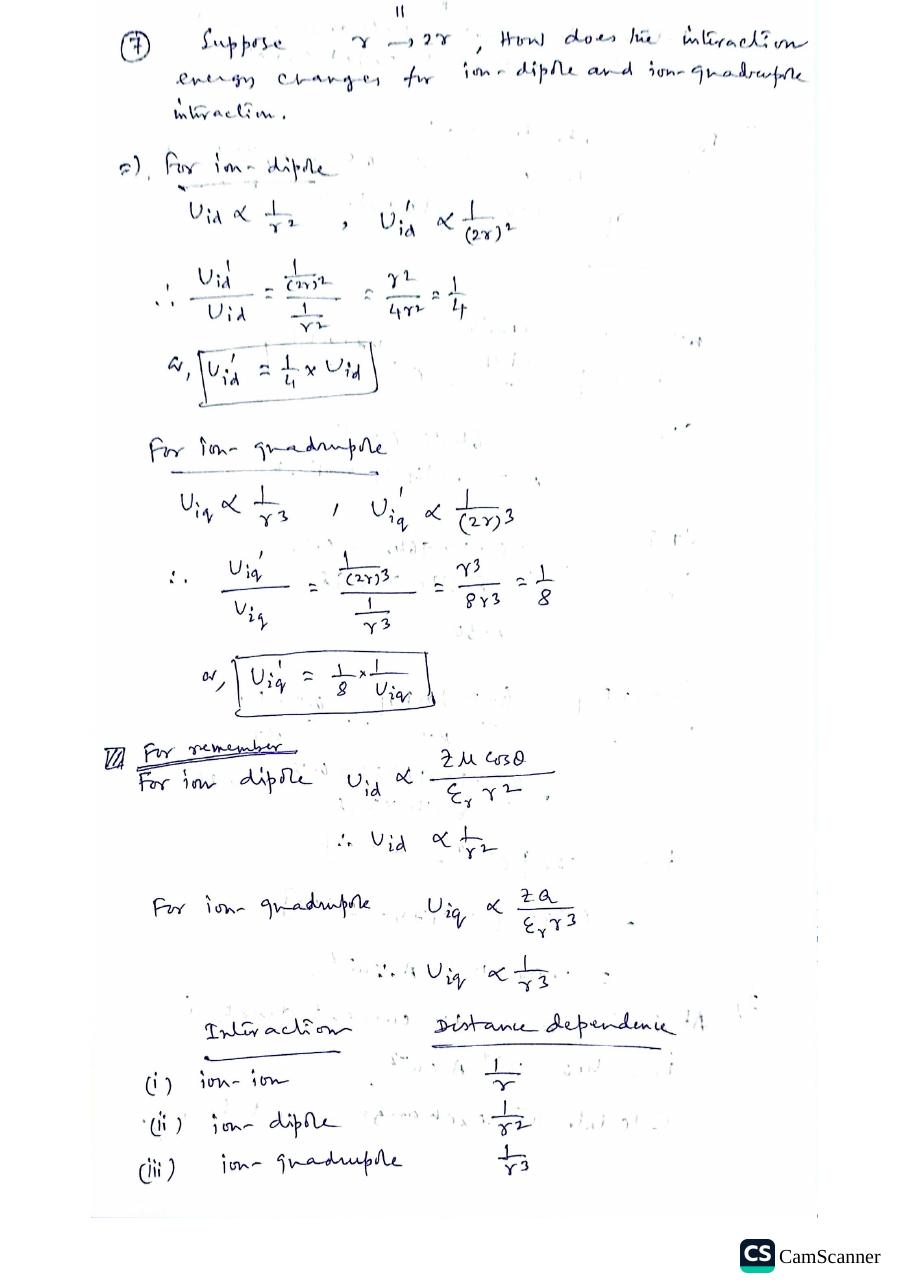 S15 · M.P. 7 + the distance-dependence table